
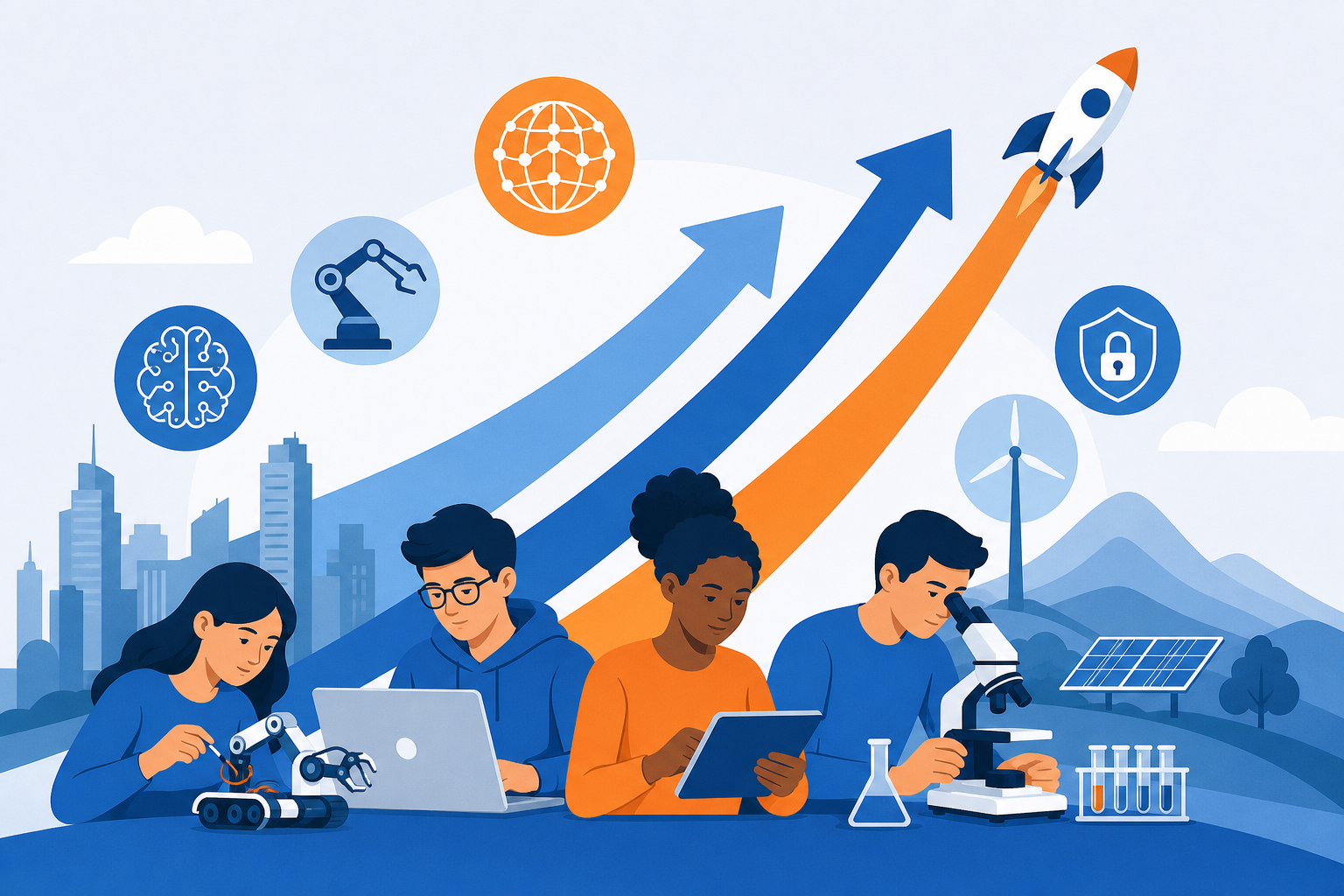
The job market is shifting faster than any single school curriculum can keep up with. Fields that barely existed a decade ago now hire thousands of professionals each year, while automation quietly reshapes roles we once thought were secure. For students planning their futures—and for the parents and teachers guiding them—understanding where the growth is happening matters as much as the grades on a report card. This guide breaks down the fastest-growing STEM careers 2034 is likely to reward, and, more importantly, the concrete skills students can start building today.
Why STEM Growth Is Accelerating
Three forces are driving demand for technical talent: the spread of artificial intelligence across every industry, the global push toward clean energy, and the constant need to defend digital systems from attack. Labor projections from major economies consistently show STEM occupations growing two to three times faster than the average job. That means more openings, higher salaries, and greater bargaining power for young people who prepare well.
But growth is uneven. A student who chases yesterday’s hot title may graduate into a crowded field, while the truly future STEM jobs reward those who understand where technology is heading. Let’s look at the roles with the strongest momentum.
The Fastest-Growing STEM Careers
1. Artificial Intelligence and Machine Learning Specialists
Demand for people who can build, train, and audit AI systems is exploding. This category includes machine learning engineers, prompt engineers, and AI ethics reviewers. A hospital might hire a specialist to help a model read medical scans accurately; a retailer might need someone to fine-tune a recommendation engine. The common thread is the ability to translate messy real-world problems into something a computer can solve responsibly.
2. Data Scientists and Data Analysts
Every organization now collects more data than it can interpret. Data professionals turn raw numbers into decisions—predicting which customers will leave, spotting fraud, or forecasting supply shortages. Because the tools are approachable, this is one of the most accessible entry points into a high-paying technical career.
3. Cybersecurity Analysts
As more of daily life moves online, the cost of a breach keeps climbing. Companies, governments, and even schools need analysts who can detect intrusions, secure networks, and respond to incidents. The shortage of qualified people in this field is severe, which means strong job security and clear paths for advancement.
4. Renewable Energy and Sustainability Engineers
Solar installers, wind turbine technicians, and energy storage engineers are among the fastest-growing roles anywhere. Beyond hardware, sustainability analysts help businesses measure and reduce their environmental impact. A background in physics, chemistry, or mechanical engineering opens many of these doors.
5. Healthcare Technology and Biotechnology Roles
Bioinformatics specialists, genetic counselors, and medical device engineers sit at the crossroads of biology and computing. As personalized medicine matures, the demand for people who can bridge lab science and software will only grow.
6. Robotics and Automation Technicians
Warehouses, farms, and factories increasingly rely on robots that need people to design, program, and maintain them. This field rewards hands-on problem solvers who enjoy both mechanical work and coding.
The Skills That Cut Across Every Path
Job titles will keep changing, so the smartest strategy is to build transferable skills. Here are the ones that show up again and again in listings for future STEM jobs.
Programming Fundamentals
You do not need to become a professional software developer, but comfort with a language like Python is now a baseline expectation across data science, AI, and even lab research. Start with small projects—automating a spreadsheet, building a simple calculator, or analyzing a dataset that interests you.
Data Literacy
The ability to read a chart critically, question a statistic, and draw honest conclusions is valuable in every field. Students can practice by exploring public datasets on topics they care about, from local weather to sports statistics.
AI Literacy
Knowing how AI tools work—their strengths, their blind spots, and their ethical risks—is quickly becoming as essential as knowing how to use a search engine. Learn to write effective prompts, verify AI output, and recognize when a model is guessing rather than knowing.
Systems Thinking
Complex problems rarely have one cause. Whether you are securing a network or designing a solar array, you need to see how parts connect. Practicing this mindset early—by mapping out how a decision ripples through a system—pays off in almost any technical role.
Communication and Collaboration
The most valuable technical professionals can explain their work to non-experts. A data scientist who cannot present findings clearly, or an engineer who cannot work on a team, quickly hits a ceiling. These so-called soft skills are often what separate a good candidate from a great one.
A Practical Roadmap for Students
The skills above can feel overwhelming, so here is a manageable way to build them over time.
- Middle school: Focus on curiosity. Try coding games, science fairs, and building projects. The goal is to enjoy problem solving, not to specialize.
- Early high school: Pick one programming language and one area of interest. Take free online courses, join a robotics or coding club, and complete small personal projects you can show others.
- Later high school: Deepen your knowledge with more challenging coursework, an internship, or a competition. Start a simple portfolio—a website or repository that documents what you have built.
- College and beyond: Combine a technical foundation with real-world experience. Seek internships, contribute to open projects, and keep learning as tools evolve.
How Parents and Teachers Can Help
Adults do not need to be experts to be effective guides. Encourage projects that solve real problems in your home or community—tracking household energy use, building a small website for a local club, or analyzing a dataset together. Celebrate effort and iteration rather than perfect results, because resilience is one of the strongest predictors of success in technical fields. Point students toward reputable online courses, local maker spaces, and mentorship opportunities.
Staying Adaptable Is the Real Skill
No one can predict exactly which job titles will dominate a decade from now. The safest bet is not to memorize a single career path but to become a confident, adaptable learner. The skills for STEM students that matter most—coding, data literacy, AI awareness, systems thinking, and clear communication—will remain relevant even as specific tools rise and fade.
Students who start building these abilities now will not just be ready for the fastest-growing careers of 2034. They will be ready to shape whatever comes after. The best time to start is today, with a single small project and the willingness to keep going.