Imagine a biology class where students walk through a beating human heart, or a physics lesson where learners manipulate gravity on the surface of Mars. This is no longer science fiction. Virtual reality in education is turning abstract concepts into hands-on experiences, and it is reshaping how students engage with science, technology, engineering, arts, and mathematics. In this article, we explore how immersive technology is transforming STEAM learning and offer practical steps for bringing it into your classroom or home.
Why Immersive Technology Matters for STEAM
STEAM subjects often ask students to visualize things they cannot see or touch: molecular bonds, planetary orbits, electrical circuits, or geometric proofs. Traditional textbooks and two-dimensional diagrams only go so far. Immersive technology closes that gap by placing learners inside the concept itself.
When a student can rotate a three-dimensional model of a DNA strand with their hands, or step inside a chemical reaction, learning shifts from passive reading to active discovery. Research consistently shows that this kind of experiential learning improves retention, boosts motivation, and helps students grasp complex ideas faster than static materials alone.
For STEAM specifically, VR delivers three powerful advantages: it makes the invisible visible, it lets students practice safely, and it sparks the curiosity that drives lasting engagement.
How VR STEAM Learning Works in Practice
Let’s look at concrete examples across the STEAM disciplines to see how VR STEAM learning comes to life.
Science
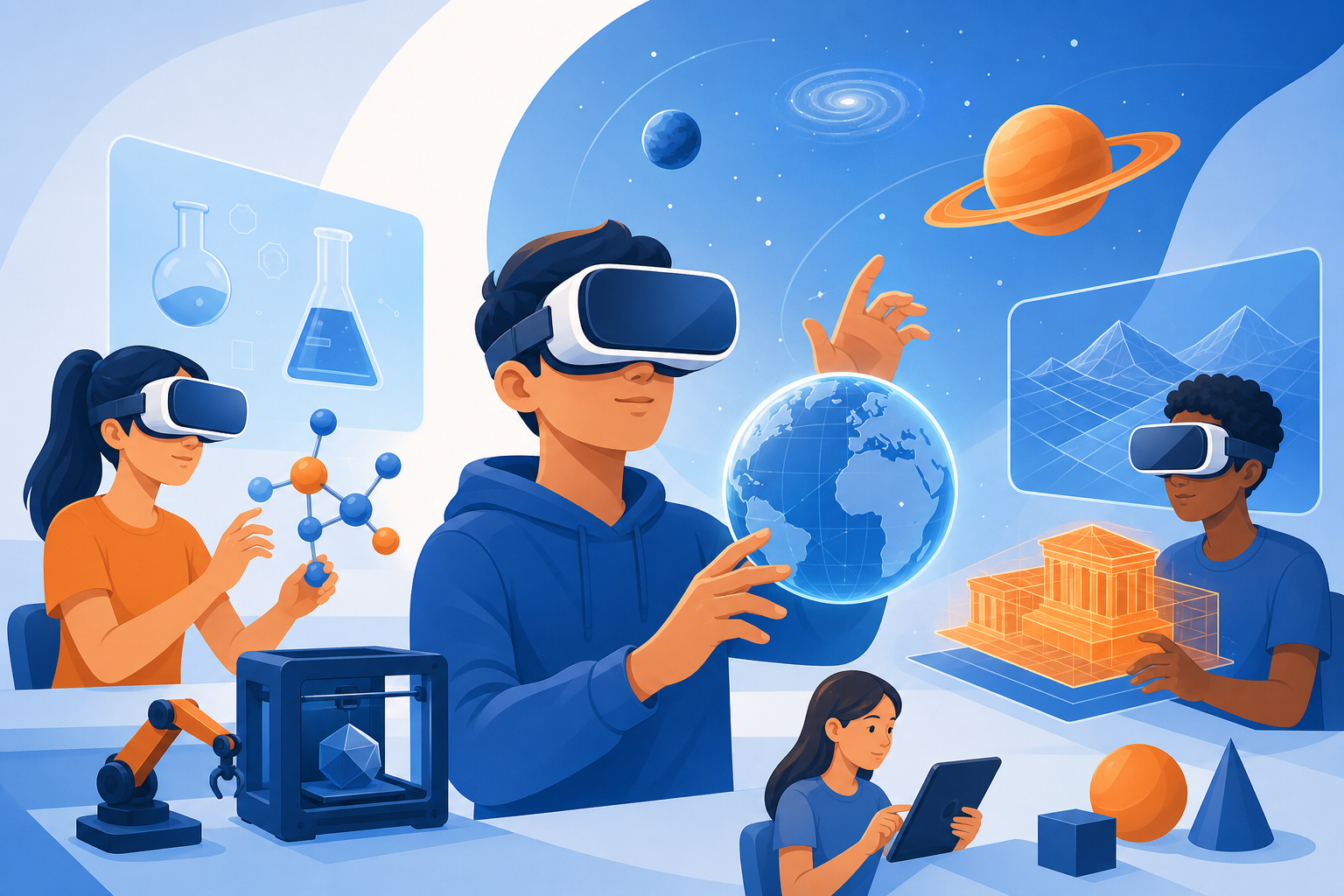
Instead of memorizing the parts of a cell, students can shrink down and travel through one. Applications like Labster and Nanome allow learners to conduct virtual chemistry experiments, explore molecular structures, and repeat procedures as many times as needed without wasting materials or risking safety. A student can mix volatile chemicals with zero danger and instantly see the consequences of a mistake.
Technology and Engineering
VR lets students design and test structures before building anything physical. Engineering learners can assemble a bridge, apply simulated stress, and watch it fail, then iterate on their design. This mirrors the real engineering process and teaches resilience through trial and error. Coding and robotics concepts also become tangible when students can visualize how a program controls a virtual machine.
Arts
Creative tools such as Tilt Brush and Gravity Sketch turn empty space into a three-dimensional canvas. Students paint in the air, sculpt digital forms, and explore perspective in ways a flat screen cannot offer. The arts component of STEAM thrives here, blending technical skill with creative expression.
Mathematics
Abstract math becomes concrete when students can walk around a geometric solid or manipulate graphs in three dimensions. Visualizing calculus concepts, exploring fractals, or understanding the volume of complex shapes all become intuitive when learners can see and touch them from every angle.
Real Benefits for Different Learners
One of the greatest strengths of immersive technology in classrooms is its ability to reach diverse learners. Visual and kinesthetic students, who often struggle with lecture-heavy instruction, tend to flourish in immersive environments. Students with attention challenges frequently show stronger focus because the experience is engaging and interactive.
VR also promotes equity by offering experiences that would otherwise be impossible or too expensive. A rural school with a limited budget can send students on a virtual field trip to the International Space Station, a coral reef, or an ancient archaeological site. These experiences level the playing field and expand horizons far beyond the classroom walls.
For learners with anxiety or physical limitations, VR provides a safe, controlled space to practice skills, from public speaking to laboratory procedures, at their own pace.
Getting Started: A Practical Roadmap
Adopting VR does not require a massive budget or a technology degree. Here is a step-by-step approach for teachers, parents, and school leaders.
1. Start Small and Focused
Begin with a single clear learning objective rather than trying to overhaul your entire curriculum. Choose one lesson where visualization is a genuine challenge, such as understanding the solar system or the structure of an atom, and pilot a VR experience there.
2. Choose Accessible Hardware
You do not need a room full of expensive headsets. Standalone devices like the Meta Quest are affordable and require no external computer. For very tight budgets, simple smartphone-based viewers paired with free apps offer an entry point. Even one or two headsets shared in a rotation station can transform a lesson.
3. Curate Quality Content
Explore trusted platforms built for education. Google Expeditions successors, ClassVR, Nearpod VR, and subject-specific tools like Labster provide ready-made, standards-aligned experiences. Preview every experience yourself before assigning it to ensure it fits your goals and is age-appropriate.
4. Integrate, Don’t Isolate
VR works best as one part of a broader lesson, not a standalone gimmick. Pair the immersive experience with discussion, note-taking, and follow-up activities. For example, after a virtual tour of the human circulatory system, have students diagram what they saw and explain it to a partner.
5. Prioritize Safety and Comfort
Keep sessions short, typically ten to fifteen minutes, to avoid eye strain and motion sickness. Clear a physical space so students do not bump into objects, sanitize headsets between users, and always supervise use. Set clear ground rules before students put on the headset.
Overcoming Common Challenges
Cost remains the most cited barrier, but prices continue to fall and grant opportunities for educational technology are widely available. Many districts start with a shared cart of devices that rotates between classrooms.
Teacher confidence is another hurdle. The solution is professional development and peer collaboration. Start with a small group of enthusiastic educators who can model successful use and support their colleagues. Vendors and online communities often provide free training resources.
Finally, be mindful of screen time and balance. VR should complement human interaction, hands-on projects, and outdoor learning, not replace them. The goal is to enrich the learning experience, not to keep students permanently plugged in.
The Future of Immersive Learning
As hardware becomes lighter, cheaper, and more powerful, VR will move from a novelty to a standard educational tool. Emerging developments like collaborative virtual classrooms allow students in different locations to work together in the same simulated laboratory. Combined with artificial intelligence, future systems will adapt experiences to each learner’s pace and needs in real time.
For educators and families invested in STEAM, now is the ideal moment to build familiarity with these tools. Early adopters will be best positioned to guide students through a future where immersive learning is woven into everyday education.
Final Thoughts
Virtual reality is more than a flashy trend; it is a genuine shift in how students can understand the world around them. By making abstract STEAM concepts tangible, engaging diverse learners, and expanding access to experiences once out of reach, immersive technology is opening new doors in education. Start small, focus on clear learning goals, and let curiosity lead the way. The classroom of tomorrow is already within reach, and it is waiting for you to step inside.