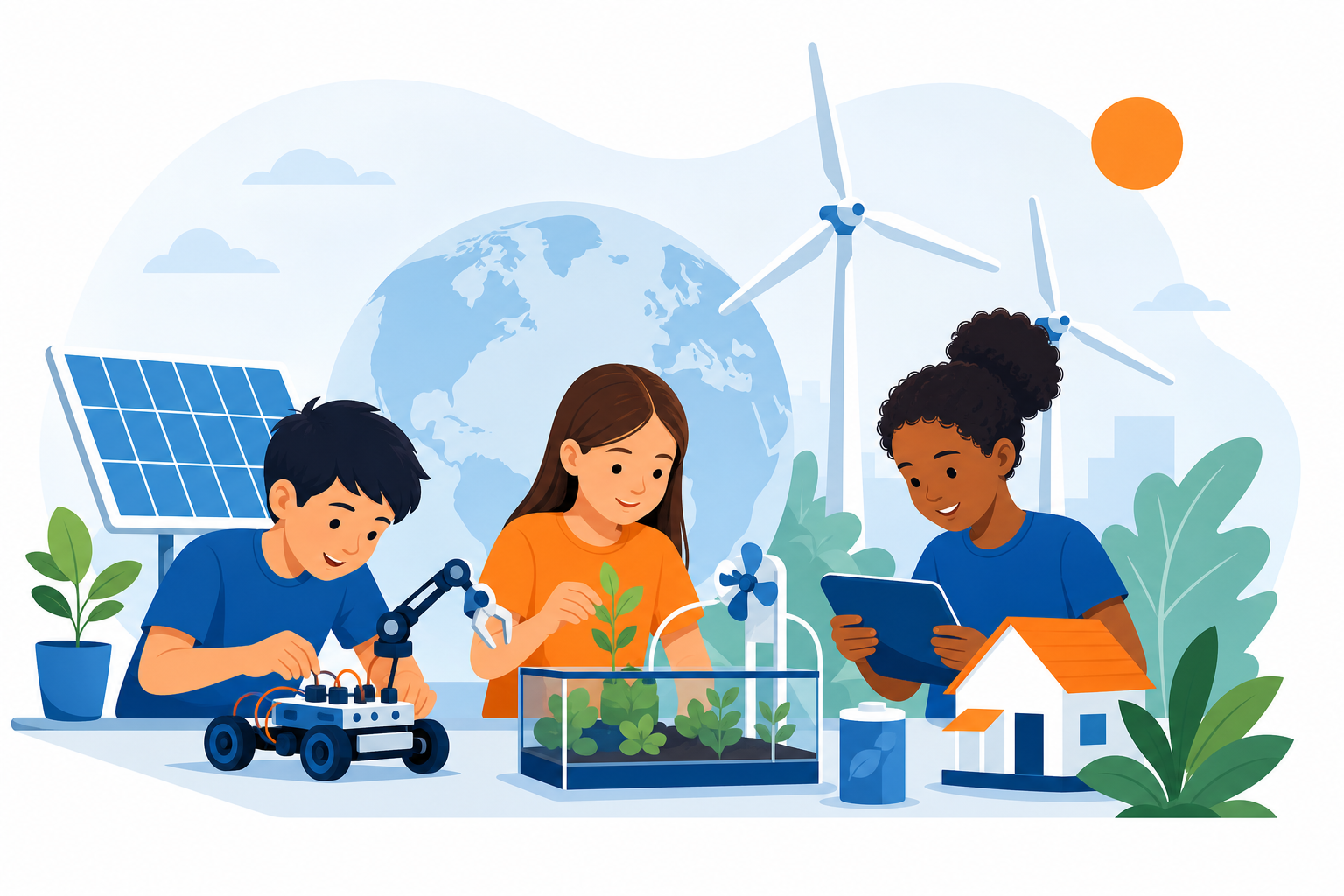
Children today are growing up in a world where climate change, renewable energy, and resource conservation are part of everyday conversation. Teaching them about green technology for kids is one of the most powerful ways to prepare them for the future while nurturing curiosity, creativity, and problem-solving skills. When you combine environmental awareness with hands-on STEAM learning, you get something remarkable: young people who not only understand sustainability but feel empowered to build solutions of their own.
In this guide, you will find practical, engaging sustainability STEAM projects that families, teachers, and after-school programs can use right away. Each project blends science, technology, engineering, art, and mathematics with real-world environmental thinking.
Why Green Technology Belongs in STEAM Education
STEAM education thrives on real problems, and few problems are more compelling to children than protecting the planet they will inherit. Introducing eco-friendly STEM projects gives abstract concepts a concrete purpose. Instead of memorizing facts about pollution, kids design a water filter. Instead of reading about solar power, they build a device that runs on sunlight.
This approach delivers several benefits at once:
- Deeper engagement: Children stay motivated when their work has meaning and visible results.
- Systems thinking: Sustainability teaches learners to see connections between energy, waste, water, and communities.
- Innovation mindset: Green challenges invite creative solutions rather than single correct answers.
- Career readiness: Renewable energy, environmental engineering, and sustainable design are among the fastest-growing fields.
Getting Started: A Few Simple Principles
Before diving into specific activities, keep these guidelines in mind to make green technology projects successful and safe.
Start with a question
Frame each project around a genuine question, such as “How can we clean dirty water?” or “Can we power a small light without batteries?” Questions spark investigation far more effectively than instructions.
Use recycled and low-cost materials
Cardboard, plastic bottles, aluminum foil, old electronics, and craft supplies are perfect. Using reclaimed materials reinforces the very sustainability lessons you are teaching.
Encourage documentation
Have children sketch designs, record measurements, and photograph their progress. This builds scientific habits and lets them reflect on what worked and what failed.
Five Hands-On Sustainability STEAM Projects
These projects are organized from simplest to most advanced, so you can match them to your learners’ ages and experience.
1. Build a Solar Oven
A solar oven is a classic introduction to renewable energy. Using a pizza box, aluminum foil, black paper, and plastic wrap, children construct an insulated container that traps sunlight to melt chocolate or warm a small snack.
What kids learn: Heat transfer, reflection, and the power of the sun. Ask them to measure the temperature inside over time and graph the results, connecting the activity to mathematics and data analysis. Encourage them to redesign the reflector angle to boost performance, which teaches iterative engineering.
2. Design a Water Filtration System
Access to clean water is a global challenge, and this project makes it tangible. Using a cut plastic bottle, cotton, sand, gravel, and activated charcoal, learners create layered filters and test how well each layer removes dirt from muddy water.
What kids learn: Filtration, the properties of materials, and environmental engineering. Extend the lesson by discussing where clean water comes from in your community and why conservation matters. Older students can compare filtration speed against clarity, introducing trade-offs in real design work.
3. Create a Wind-Powered Machine
Wind energy comes alive when kids build a small turbine from cardboard blades, a straw, and a plastic cup weighted with paper clips. Positioned in front of a fan, the turbine can lift a light load, demonstrating how moving air becomes useful energy.
What kids learn: Aerodynamics, gear ratios, and energy conversion. Challenge them to change blade shape, number, and angle to lift more weight. This experiment naturally rewards experimentation and careful observation.
4. Build a Mini Greenhouse and Track Plant Growth
Combine biology with sustainable food production by building a small greenhouse from clear plastic containers. Children plant seeds, control watering, and monitor how temperature and light affect growth.
What kids learn: Photosynthesis, the water cycle, and sustainable agriculture. Add a mathematics component by measuring plant height daily and predicting future growth. Discuss composting and how food scraps can become nutrients, closing the loop on waste.
5. Program a Smart Energy Monitor
For older kids ready for technology and coding, a microcontroller such as a low-cost programmable board can be used to build a simple light or motion sensor that turns off a lamp when a room is empty. Even a basic block-coding simulation counts.
What kids learn: Coding logic, sensors, and how automation reduces energy waste. This project bridges digital skills with environmental impact and shows how everyday devices can be made smarter and greener.
Adding the Art in STEAM
Art is often overlooked in environmental projects, yet it is essential for communication and design. Encourage children to:
- Create posters that explain their invention and its benefits.
- Design product packaging using only recyclable materials.
- Film short videos demonstrating how their project works and why it matters.
- Sketch prototypes before building, treating drawing as a planning tool.
These creative tasks strengthen communication skills and help kids see that innovation is about sharing ideas as much as building them.
Connecting Projects to Real-World Impact
To make green technology feel meaningful, tie each activity to something children can observe in their own lives. After building a solar oven, discuss solar panels on rooftops. After filtering water, talk about the importance of protecting local rivers. These conversations transform a fun afternoon into lasting understanding.
You can also invite learners to identify a small environmental problem at home or school, such as wasted paper or lights left on, and design a simple solution. This turns them from passive learners into active problem-solvers, which is the ultimate goal of any strong STEAM program.
Tips for Parents and Teachers
To get the most out of these eco-friendly STEM projects, keep the following in mind:
- Embrace failure: A collapsed turbine or leaky filter is a learning opportunity, not a mistake.
- Ask open questions: Instead of giving answers, ask “What do you think will happen if you change this?”
- Work in teams: Collaboration mirrors how real engineers and scientists solve problems.
- Celebrate progress: Host a mini showcase where children present their inventions to family or classmates.
Final Thoughts
Teaching green technology for kids is about far more than science lessons. It is about raising a generation that believes in its ability to build a cleaner, smarter, and more sustainable world. With a few simple materials and the projects above, you can transform curiosity into confidence and ideas into action. Start with one activity this week, and watch how quickly young minds turn concern for the planet into genuine innovation.