
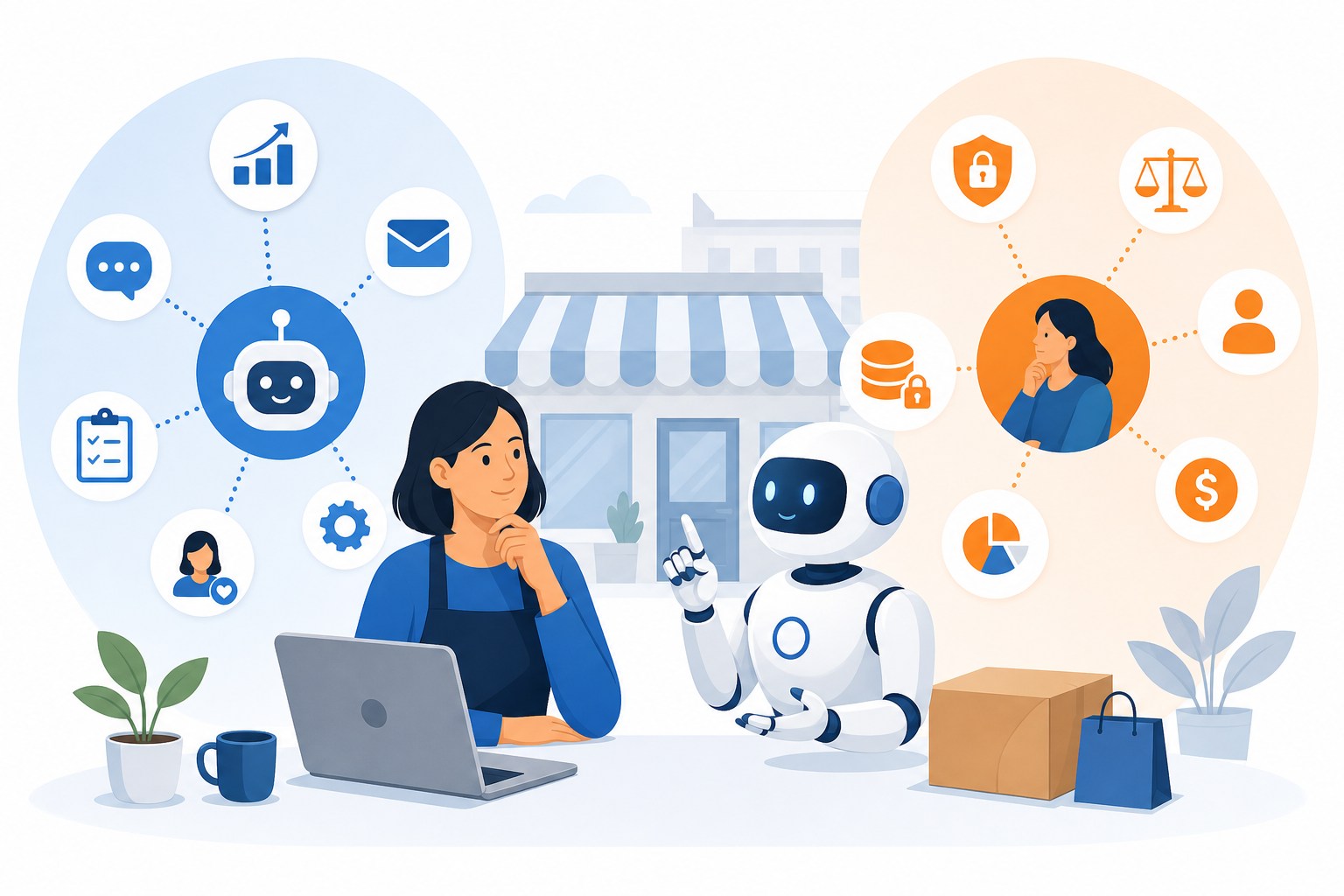
Artificial intelligence has moved beyond chatbots that answer basic questions. Today, AI agents for business can complete multi-step tasks, make decisions within set limits, and connect to the tools you already use. For a small business owner juggling sales, customer service, and operations, this shift is significant. But adopting new technology without a plan can waste money and create headaches. This guide explains what AI agents actually do, where they add value, and what to weigh before you bring them into your workflow.
What Is an AI Agent, Exactly?
An AI agent is software that can take a goal, break it into steps, and act on your behalf across different systems. Unlike a simple chatbot that only responds to prompts, an agent can plan, use tools, and follow through. For example, if you ask an agent to “follow up with leads who haven’t replied in five days,” it can check your customer records, draft personalized messages, and schedule them to send at the right time.
Think of the difference this way: a traditional automation rule does exactly one thing when triggered. An AI agent can adapt. If a customer replies with a question the agent wasn’t expecting, it can interpret the message and respond appropriately rather than breaking down. This flexibility is what makes AI agents small business owners are trying today feel genuinely helpful rather than just clever.
What AI Agents Can Do for a Small Business
The most useful applications tend to be repetitive, time-consuming tasks that don’t require your personal judgment. Here are areas where owners see the fastest results.
Customer Support and Communication
An agent can handle routine inquiries around the clock: order status, opening hours, return policies, and appointment booking. When a question is too complex, it can hand off to a human with a full summary of the conversation. A local dental clinic, for instance, could use an agent to confirm appointments, send reminders, and reschedule cancellations without staff lifting a finger.
Sales and Lead Management
Agents can qualify incoming leads by asking a few targeted questions, log the answers in your customer relationship management system, and route hot prospects to your sales team. They can also send timely follow-ups so no opportunity slips through the cracks. A freelance consultant might use an agent to screen inquiries, filter out mismatched requests, and book discovery calls only with clients who fit.
Administrative and Back-Office Work
This is where AI automation tools quietly save hours. Agents can sort invoices, extract key details from receipts, update spreadsheets, and prepare draft reports. A small retail shop could have an agent reconcile daily sales figures across its point-of-sale system and accounting software, flagging anything that doesn’t add up.
Marketing and Content Support
An agent can draft social media posts, repurpose a blog article into an email newsletter, and suggest subject lines based on what performed well before. It won’t replace your brand voice, but it can produce a solid first draft that you refine in minutes instead of writing from scratch.
Real Benefits Beyond Saving Time
Time savings are the obvious win, but there are others worth naming. Consistency is a big one: an agent applies the same standards to every customer, so quality doesn’t dip when you’re busy. Availability matters too, since an agent works overnight and on weekends without overtime costs. And because agents log everything they do, you gain a clearer record of customer interactions and internal processes than you might have had before.
Crucially, these tools let a lean team punch above its weight. A three-person company can offer response times and follow-through that once required a much larger staff. That competitive edge is the real reason so many owners are paying attention.
What to Consider Before You Adopt an AI Agent
The technology is powerful, but it isn’t plug-and-play magic. Rushing in creates risk. Here are the factors to think through carefully.
Data Privacy and Security
AI agents often need access to customer data, payment details, or internal documents. Before granting access, ask where the data is stored, whether it’s used to train the provider’s models, and what security certifications the vendor holds. If you handle sensitive information, confirm the tool complies with the privacy regulations that apply to your region and industry. Never connect an agent to critical systems without understanding exactly what it can see and change.
Accuracy and Oversight
AI can make confident mistakes. It might quote the wrong price, misread a document, or invent an answer that sounds plausible. For any task where an error is costly, keep a human in the loop. A good practice is to start with the agent drafting and a person approving, then loosen that supervision only once you trust its reliability in that specific task.
Integration With Your Existing Tools
An agent is only as useful as its connections. Check whether it works with the systems you already rely on, such as your email platform, calendar, accounting software, and customer database. A tool that can’t connect to your stack will force manual copying and paste, which defeats the purpose. Many platforms list their supported integrations openly, so review that before committing.
Cost Versus Real Value
Pricing models vary widely, from flat monthly fees to charges based on usage. Estimate the volume of tasks you’ll actually run, and beware of costs that scale unpredictably as you grow. Compare that against the hours you’ll reclaim. If an agent saves ten hours a week that you can redirect to revenue-generating work, a modest subscription pays for itself quickly.
Team Readiness and Training
Your staff will need to understand what the agent does and how to work alongside it. Involve them early, explain that the goal is to remove tedious work rather than replace people, and give them clear guidance on when to step in. Adoption fails most often not because of the technology but because the team wasn’t prepared for it.
A Practical Way to Start
Don’t try to automate everything at once. Choose one repetitive, low-risk task that eats up time every week, such as answering common customer questions or logging leads. Set up an agent for that single task, measure the results over a month, and gather feedback from your team and customers. If it works, expand step by step. This measured approach keeps risk low and lets you build genuine confidence in the tools.
Document what you learn along the way: what the agent handles well, where it struggles, and which guardrails you added. That record becomes a playbook you can reuse as you introduce agents to other parts of the business.
The Bottom Line
AI agents offer small businesses a rare chance to operate with the efficiency of a much larger company. They handle repetitive work, respond around the clock, and free you to focus on strategy and relationships. But the smart move is deliberate adoption: protect your data, keep humans overseeing important decisions, confirm the tools fit your existing systems, and start small. Approached this way, AI agents become a dependable member of your team rather than a risky experiment, and the time you save today compounds into a stronger, more competitive business tomorrow.


