Renewable Energy Projects for Students: Easy STEM Ideas for the Classroom
Renewable energy is one of the best STEM topics for helping students connect what they learn in class to real-world challenges. It brings together science, engineering, technology, sustainability, and problem-solving in a way that feels practical and meaningful. Instead of only talking about energy in abstract terms, students can explore how sunlight, wind, and water can be transformed into usable power through hands-on projects and classroom experiments. The U.S. Department of Energy and the National Renewable Energy Laboratory both provide student and teacher resources specifically designed to help learners investigate renewable energy through classroom-friendly activities, projects, and guides.
For SkillUp, this topic is especially relevant. The site’s student curriculum already includes renewable energy and sustainability as core themes, with activities such as presentations on renewable energy and building a model like a solar panel. That means renewable energy projects are not just a good SEO topic for the site. They are already part of the educational experience SkillUp is offering to students.
Why renewable energy is such a strong STEM topic
Renewable energy works extremely well in STEM education because it naturally combines theory and application. Students can learn scientific ideas such as energy transfer, motion, light, and systems thinking, while also designing and testing physical models. This makes learning more active and easier to understand. NREL’s education materials emphasize helping students investigate, question, and experiment with scientific ideas, while DOE classroom guides include solar, wind, and turbine-based activities that bring energy concepts into practical lessons.
It is also a topic with strong real-world relevance. Students hear about sustainability, climate challenges, and energy choices in everyday life. Renewable energy projects help them explore those ideas in age-appropriate ways. Instead of only discussing the future, they begin to see how innovation and engineering can contribute to it. SkillUp’s own blog has already linked STEAM learning to developing renewable energy solutions and understanding global challenges, which makes this topic a natural fit for the site’s broader content strategy.
What makes a good renewable energy classroom project?
The best renewable energy projects for students are simple enough to build in a classroom but rich enough to teach multiple STEM concepts. A strong project usually has three qualities. First, it is hands-on. Students should be able to make, test, observe, or improve something. Second, it should connect to a clear scientific idea, such as how solar energy works or how turbines convert motion into energy. Third, it should invite discussion, reflection, or redesign so that students are not just following steps, but actually thinking like problem-solvers. This emphasis on investigation and experimentation is consistent with NREL’s renewable energy education materials.
1. Build a simple solar oven
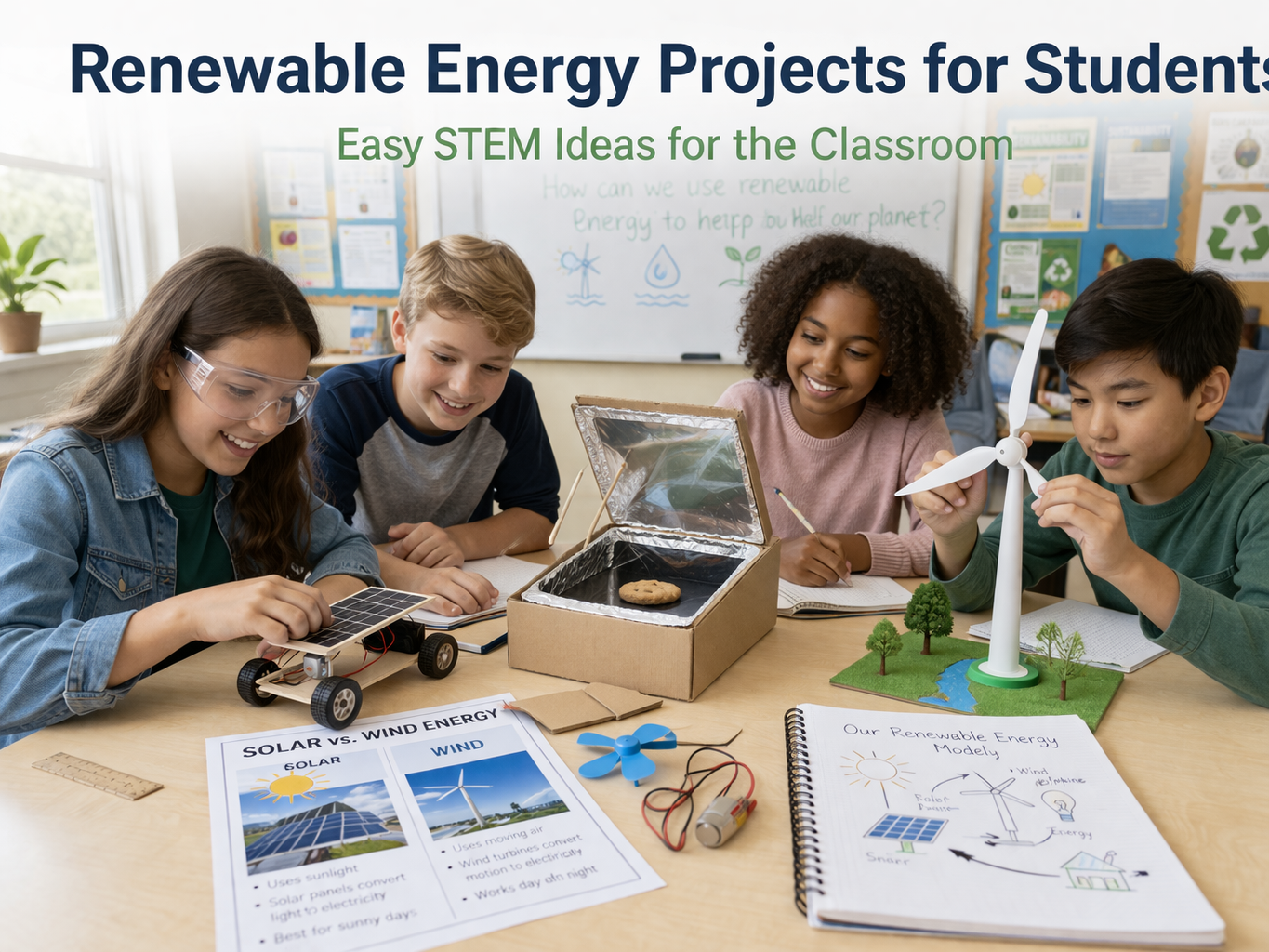
A solar oven is one of the easiest and most engaging renewable energy projects for students. Using simple materials such as a pizza box or cardboard container, foil, plastic wrap, and dark paper, students can build a model that captures heat from sunlight. This project helps them explore solar energy, heat absorption, insulation, and experimental design.
What makes a solar oven especially useful in the classroom is that students can compare results. They can test what happens when they change the angle, the reflective surface, or the insulating materials. DOE and NREL solar education guides are built around this same idea of using classroom activities to help students investigate how sunlight can be converted into useful energy.
2. Create a mini solar-powered model
Another excellent idea is to have students build or examine a simple solar-powered model, such as a mini fan, a small car, or a solar panel prototype. This activity helps students understand that solar energy can be transformed into electricity and then used to perform work.
This aligns very closely with SkillUp’s own course outline, which explicitly includes building a renewable energy model such as a solar panel. That makes the project ideal for classroom use and highly aligned with the brand’s educational promise. It also gives students a visible connection between sunlight and action, which can make energy concepts much easier to grasp.
3. Design a wind turbine blade challenge
Wind energy activities are excellent for introducing engineering thinking. Students can create different turbine blade shapes from paper, cardboard, or lightweight plastic and test which design spins most effectively under a fan or natural wind. This project encourages experimentation because students can compare blade size, angle, number, and shape.
DOE teacher materials on electricity and renewable energy include activities about how wind, water, and steam can turn turbines, and NREL’s wind education efforts have long connected student learning with practical wind energy experiences. That makes wind turbine design a strong classroom example of engineering in action.
4. Build a simple water wheel
A small water wheel project can help students understand hydropower and mechanical energy transfer. Students can create a model wheel using recycled materials and test how water flow affects movement. Even if the project does not generate electricity, it still teaches a valuable concept: moving water can produce force that performs work.
This kind of activity is especially helpful because it lets students observe energy transfer directly. DOE’s renewable energy classroom materials include activities that help students explore how wind, water, and steam can be used to turn turbines, which supports using hydropower-inspired classroom projects as part of a broader renewable energy unit.
5. Compare renewable and nonrenewable energy sources
Not every project has to involve building a device. Some of the best classroom STEM activities ask students to investigate, compare, and communicate what they learn. A useful project is to have students compare renewable and nonrenewable energy sources through posters, charts, presentations, or collaborative research stations.
NREL’s R.E.A.C.T. materials were designed to help students gain understanding of renewable and nonrenewable energy resources while building confidence in questioning and experimenting with scientific ideas. That makes comparison-based classroom projects a strong fit, especially when students are encouraged to evaluate environmental impact, availability, and sustainability.
6. Run a classroom or home energy audit
A renewable energy unit becomes even more meaningful when students connect it to conservation and sustainability. A simple classroom or home energy audit can help students observe how energy is used, where waste happens, and what changes could improve efficiency. This project supports data collection, observation, communication, and problem-solving.
DOE provides educator resources that point teachers to energy education materials, while NEED and other energy education organizations offer classroom activities related to energy efficiency and conservation. This makes energy audits a practical bridge between renewable energy learning and sustainable action.
Why these projects matter for student learning
Renewable energy projects matter because they make STEM learning visible and relevant. Students are not only hearing about science concepts. They are using them. They test ideas, compare outcomes, make changes, and explain results. That process strengthens critical thinking and gives students a clearer sense of how classroom learning can apply to real-world systems.
These projects also support future-ready thinking. Renewable energy is tied to engineering, innovation, sustainability, and emerging careers. NREL highlights student resources and competitions connected to clean energy learning, while DOE continues to support curriculum and education initiatives that help schools bring energy topics into the classroom. For students, this means renewable energy projects can be both academically valuable and motivating.
Why this topic fits SkillUp
This topic fits SkillUp extremely well because renewable energy and sustainability already appear directly in its student course sequence. The brand also positions itself around innovation, future-ready learning, and practical STEM experiences. Publishing an article on renewable energy projects for students strengthens topical authority around all three of those themes while staying closely aligned with what the site already teaches.
Conclusion
Renewable energy projects for students are some of the most effective STEM activities a classroom can use. They combine science, sustainability, engineering, and creativity in ways that feel real and engaging. Whether students build a solar oven, test wind turbine blades, create a small solar model, or complete an energy audit, they are learning how ideas turn into action.
For schools and organizations like SkillUp, these projects are especially valuable because they do more than teach content. They help students question, experiment, solve problems, and think about the role they can play in building a more sustainable future. That makes renewable energy not just a topic in STEM education, but a powerful way to make STEM learning matter.
FAQ
What are some easy renewable energy projects for students?
Easy renewable energy projects for students include building a solar oven, testing mini solar-powered models, designing wind turbine blades, building a water wheel, and conducting a classroom or home energy audit. These types of activities align well with DOE and NREL education materials.
Why are renewable energy projects good for STEM learning?
They are good for STEM learning because they combine hands-on building, scientific investigation, engineering design, and real-world sustainability topics in one activity.
Are renewable energy classroom projects suitable for younger students?
Yes. Many renewable energy education resources from DOE, NREL, and NEED include activities designed for school-age learners at different grade levels, including introductory solar and energy investigations.
Why is this topic relevant for SkillUp?
It is relevant because SkillUp already includes renewable energy and sustainability within its student curriculum, including building a model such as a solar panel and analyzing successful renewable energy cases.