
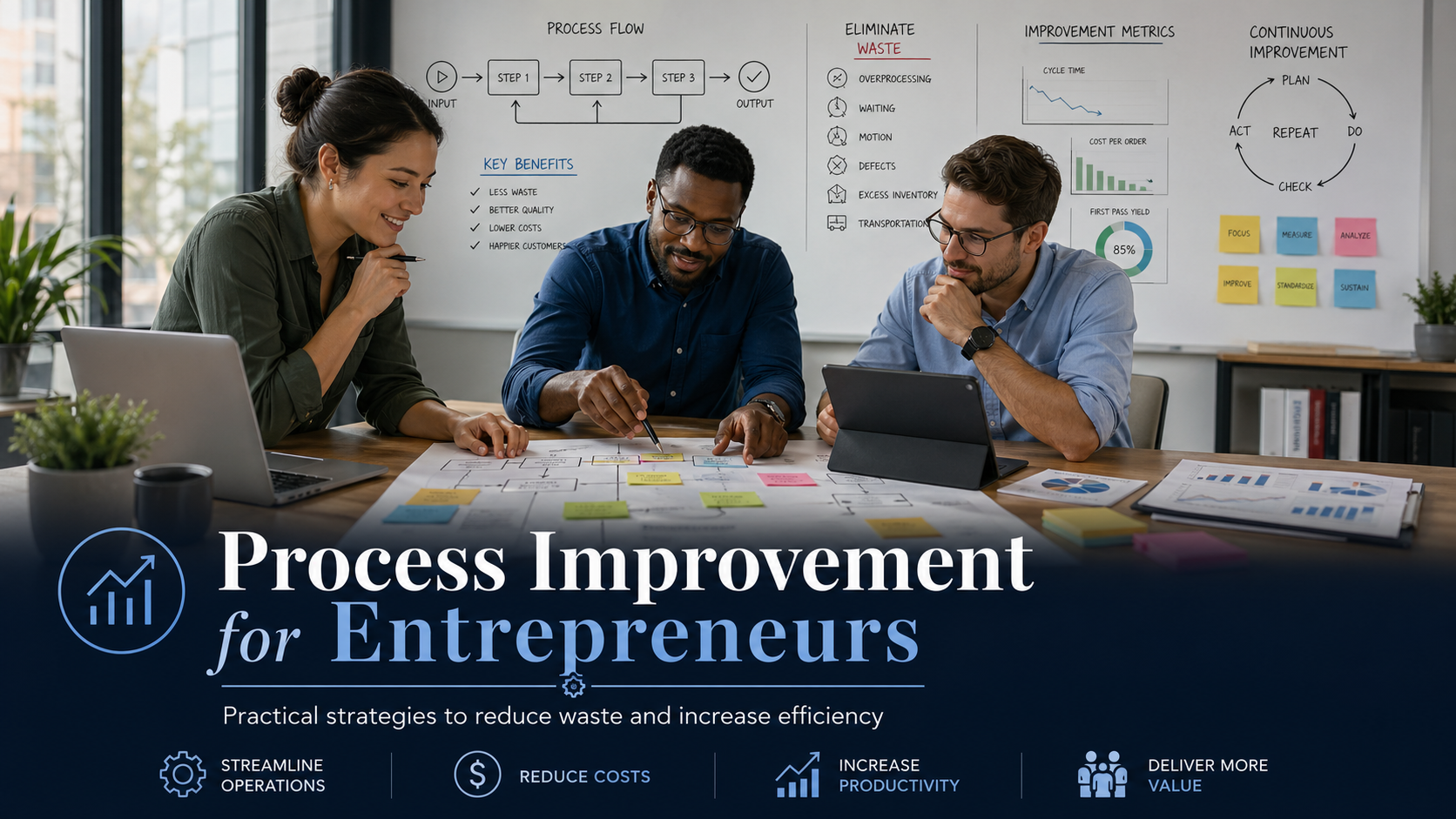
Process Improvement for Entrepreneurs: Practical Strategies to Reduce Waste and Increase Efficiency
Entrepreneurs are often excellent at spotting opportunities, creating solutions, and moving quickly. But as a business grows, speed alone is not enough. Many operational problems begin to appear when the company starts handling more customers, more tasks, and more internal coordination. Orders may take longer to complete, information may get lost between steps, and teams may spend too much time fixing recurring issues instead of moving forward. SkillUp’s consulting services are built around this exact challenge, offering support in operational optimization, process mapping, continuous improvement, technological solutions, and automation for entrepreneurs and small businesses.
That is why process improvement matters so much for entrepreneurs. Process improvement means looking at how work actually happens, identifying what slows it down, and redesigning that flow so the business can operate with less waste and more consistency. NIST explains that lean and continuous improvement approaches are designed to create a continuous flow of value to the customer and can lead to more streamlined operations, reduced defects, shorter lead times, increased productivity, and freed-up capacity. NIST also describes continuous improvement as an organizational mindset focused on ongoing effort to improve, helping firms become more agile, competitive, and profitable.
Why entrepreneurs need process improvement early
Many entrepreneurs assume process improvement is something to worry about later, when the business is bigger. In reality, it becomes valuable much earlier. Small companies often feel the effects of poor processes faster than large ones because they have less margin for wasted time, duplicated work, unnecessary movement, errors, or unclear responsibilities. A few repeated inefficiencies can quickly affect delivery times, customer experience, and profitability. NIST’s guidance on lean process improvement specifically emphasizes eliminating non-value-added activities and creating efficient flow throughout the company.
This is also why SkillUp’s entrepreneur consulting offer is so relevant. The company positions process improvement not as abstract theory, but as practical guidance to help businesses optimize operations and achieve sustainable growth. That framing is important because entrepreneurs usually do not need complexity for its own sake. They need systems that make the business run better in real life.
1. Start by mapping the process as it really works
One of the most useful first steps in process improvement is visibility. Before a business can reduce waste or improve efficiency, it needs to understand the current workflow clearly. Entrepreneurs often discover that the real process is more complicated than expected once every step is written down. NIST describes value stream mapping as a common first step in lean improvement because it helps organizations uncover waste, take a high-level view of the process, diagnose problems, and identify the right areas for improvement.
For an entrepreneur, this can be as simple as mapping one core workflow from beginning to end. That might be how a lead becomes a client, how a customer order gets fulfilled, how inventory is restocked, or how a service request gets handled. Once the flow is visible, hidden problems become easier to see. Delays, repeated approvals, missing information, unclear handoffs, and duplicated tasks usually become much more obvious when the process is documented step by step. This is a practical inference from the role NIST assigns to value stream mapping as a tool for uncovering waste and diagnosing problems.
2. Identify non-value-added activities
A major goal of process improvement is reducing waste. In lean language, waste includes activities that consume time, effort, or resources without creating real value for the customer. NIST’s materials define lean as a systematic approach to eliminating non-value-added activities and creating efficient flow.
For entrepreneurs, waste may show up in very ordinary ways. It may be too many manual data entries, repeated corrections, poor file organization, waiting for approvals, excessive movement between tools, duplicated communication, or rework caused by unclear instructions. These are not always dramatic problems, but they add up. Process improvement helps entrepreneurs separate what is necessary from what is simply familiar. That distinction can create major gains in speed and consistency. This conclusion follows directly from NIST’s description of lean methods and their focus on eliminating waste to streamline operations.
3. Use 5S to create order and reduce friction
Entrepreneurs often think of efficiency as a strategic issue, but sometimes it starts with basic organization. NIST identifies 5S—Sort, Set in order, Shine, Standardize, Sustain—as a core lean methodology used to organize the workplace so unnecessary items are removed and required tools are visible and properly placed. NIST states that the result simplifies work processes, improves workplace safety, and eases maintenance and troubleshooting.
In a small business, 5S can apply beyond a factory floor. It can improve a service desk, office workflow, digital file structure, storeroom, workshop, or order-preparation area. For example, standardizing where materials are stored, how documents are named, or how tasks are handed off can save time every day. The principle is simple: when people waste less time searching, correcting, or reorganizing, they can spend more time doing value-creating work. That is a reasoned application of NIST’s 5S guidance to small-business environments outside heavy manufacturing.
4. Build a culture of continuous improvement
One-time fixes can help, but the strongest businesses improve continuously. NIST describes continuous improvement as an organizational mindset centered on ongoing effort to improve, and it highlights tools such as Kaizen, Toyota Kata, and Six Sigma as part of broader improvement work. NIST explains that Toyota Kata supports a sustainable problem-solving culture through targeted experimentation and learning, while Six Sigma focuses on identifying causes of defects and minimizing variability in processes.
For entrepreneurs, the main lesson is not that every small business needs a formal quality department. It is that improvement should become a habit. Teams should regularly ask what is slowing work down, where errors repeat, what customers wait too long for, and which steps could be simpler. When businesses treat improvement as routine instead of occasional, efficiency becomes more durable. This is an inference from NIST’s emphasis on continuous improvement as a lasting mindset rather than a single project.
5. Improve flow before adding more tools
A common mistake in growing businesses is trying to solve messy processes by buying more software too early. Technology can be powerful, but it works best when the underlying process is already clear. SkillUp’s consulting offer combines technological solutions and automation with process mapping and operational optimization, which suggests a structured order: understand the process first, then decide what should be automated or digitized.
NIST makes a similar point by describing operational efficiency as foundational for automation and by tying lean improvement to stronger flow, reduced lead times, and better productivity. In practice, that means entrepreneurs should first identify where the real friction exists. Once that is visible, technology decisions become more strategic. The goal is not to automate confusion. It is to automate a cleaner, stronger process.
6. Measure the impact of improvements
Process improvement becomes much more effective when entrepreneurs define what success looks like before making changes. SkillUp’s consulting content includes a specific focus on evaluation techniques and key metrics for measuring the impact of implemented improvements.
That matters because improvement should be visible in business results. Depending on the process, useful measures might include turnaround time, error rate, number of touchpoints, on-time delivery, response time, customer complaints, or hours saved. NIST’s materials repeatedly connect lean and continuous improvement with measurable outcomes such as reduced defects, shorter lead times, improved productivity, and reduced cycle time.
Why this topic fits SkillUp
This topic fits SkillUp very well because it speaks directly to the consulting pillar of the brand. The site already positions its entrepreneur services around improving productive processes through applied engineering, process mapping, continuous improvement, technological solutions, and automation. Publishing content around process improvement for entrepreneurs strengthens organic relevance for exactly the services SkillUp wants to be found for.
Conclusion
Process improvement for entrepreneurs is not about making a business more complicated. It is about making work clearer, smoother, and more effective. When entrepreneurs map workflows, remove non-value-added steps, organize the workplace, build habits of continuous improvement, and measure results, they create a stronger foundation for growth. NIST’s guidance shows that these approaches can reduce waste, shorten lead times, improve productivity, and support more agile operations. SkillUp’s consulting model translates that kind of thinking into practical support for entrepreneurs who want to improve how their businesses run.
FAQ
What is process improvement for entrepreneurs?
Process improvement for entrepreneurs means analyzing how work is done, identifying waste or bottlenecks, and redesigning workflows to make operations more efficient and consistent. SkillUp presents this through services such as process mapping, continuous improvement, and operational optimization.
How can entrepreneurs reduce waste in a business process?
Entrepreneurs can reduce waste by mapping the workflow, identifying non-value-added activities, organizing the workplace, and simplifying unnecessary steps. NIST describes lean improvement as a systematic way to eliminate waste and improve flow.
What is value stream mapping?
Value stream mapping is a lean tool that helps businesses take a high-level view of a process, uncover waste, diagnose problems, and identify where improvements should happen first.
Why is this topic relevant for SkillUp?
It is relevant because SkillUp already offers consulting for entrepreneurs focused on process mapping, continuous improvement, technological solutions, automation, and sustainable operational growth.