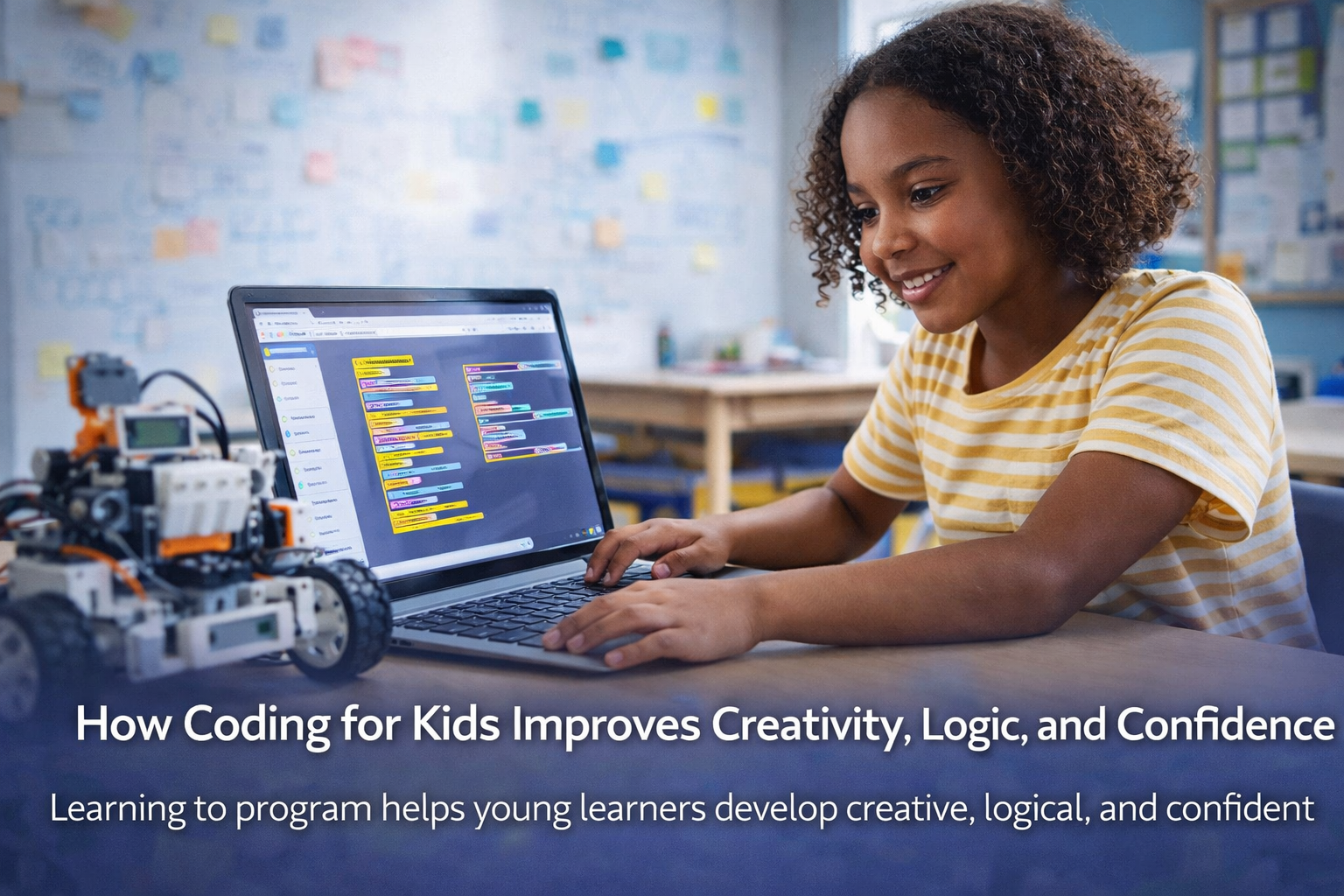
How Coding for Kids Improves Creativity, Logic, and Confidence
Coding is often introduced as a technical skill, but for young learners, it is much more than that. It can become a creative tool, a way of thinking, and a practical method for solving problems. UNESCO describes coding as a new form of literacy and says it is more than a technical skill because it combines logic, creativity, and problem-solving. That makes coding especially valuable for students growing up in a world shaped by digital systems and emerging technologies.
For SkillUp, this topic is a natural fit. The site’s student programs are designed for ages 10 to 18 and emphasize hands-on activities, collaborative projects, real-world applications, curiosity, creativity, and critical thinking. SkillUp’s course schedule also includes an introduction to programming, showing that coding already sits inside the educational model the brand is building.
Why coding matters for young learners
One reason coding matters so much is that it shifts students from passive technology use to active creation. Instead of only consuming apps, games, and digital content, students learn how these systems work and how they can make their own. UNESCO’s World Coding Day materials frame coding as a way for learners not only to use technology, but to co-create it. That distinction is important because it changes how students see themselves: not just as users, but as builders and creators.
This also aligns with how modern computer science education is increasingly presented. Code.org, one of the most widely used K–12 computer science providers in the United States, says its curriculum helps students learn with creativity and offers standards-aligned computing experiences from elementary through high school. That supports the broader idea that coding education is not only about preparing for technical careers. It is also about helping students think, create, and participate more fully in the digital world around them.
1. Coding helps kids express creativity in new ways
A common misconception is that coding is rigid or purely logical. In reality, coding can be one of the most creative things a student learns. Harvard Graduate School of Education highlights coding as a form of creative expression that helps young people get their ideas out into the world. When students code a game, an animation, an interactive story, or a simple digital tool, they are not just following instructions. They are turning imagination into something visible and functional.
That matters because creativity grows when students have room to make choices, try ideas, and build something that feels like their own. Coding gives them that space. They can experiment with how a character moves, how a system responds, how colors and design work together, or how a sequence creates a result. In that sense, coding is not separate from creativity. It is one more medium through which students can invent, design, and communicate ideas.
2. Coding strengthens logic and structured thinking
Coding also helps students develop logic. To make a program work, students need to think in steps. They learn how actions happen in sequence, how conditions affect outcomes, and how one instruction connects to another. UNESCO explicitly describes coding as a language of logic, while education frameworks around computational thinking commonly describe it as a problem-solving approach based on logical and algorithmic reasoning.
This kind of structured thinking is useful far beyond programming. When students practice sequencing, identifying patterns, and building clear instructions, they strengthen habits that support mathematics, science, engineering, and everyday decision-making. Code.org’s curriculum descriptions also emphasize helping students guide problem-solving and understand the real-world applications of computing, which reinforces the role of coding in building logical thinking that transfers across subjects.
3. Coding teaches students how to get unstuck
One of the most valuable parts of learning to code is that students quickly discover that things do not always work the first time. A line of code may contain an error. A command may not produce the expected result. A project may need revision before it works correctly. Harvard’s Creative Computing research describes programming as a process of getting stuck and getting unstuck, where learners encounter bugs, frustration, and the need for support.
This is important because it turns mistakes into part of the learning process. Students begin to see that errors are not proof that they are “bad at coding.” They are clues that help them improve. That shift is powerful. It builds persistence, patience, and a more constructive relationship with difficulty. Instead of avoiding problems, students learn to investigate them. And that mindset supports not only coding, but learning in general.
4. Coding can build confidence through visible progress
Confidence often grows when students can see the result of their thinking. Coding offers this in a very direct way. A student writes instructions, changes something, tests it, and watches the outcome appear on screen. UNESCO’s coding education materials include student testimony describing coding as a way to build computational thinking and confidence, which is especially meaningful because it reflects the learner experience, not just institutional theory.
This visible progress matters for young learners. They do not have to wait weeks to feel success. They can often experience it within a single session: a sprite moves, a game works, an animation responds, or a bug gets fixed. Those moments can make students feel capable. Over time, that sense of capability can become genuine confidence, especially when coding is taught in supportive, age-appropriate ways. Harvard’s work also emphasizes that better learning structures and collaborative support help students move past frustration and build a healthier identity as learners of computing.
5. Coding supports problem-solving and computational thinking
Coding naturally develops problem-solving because programming is essentially a process of designing solutions. Students have to understand the goal, decide what steps are needed, test whether those steps work, and revise as necessary. UNESCO connects youth coding with creativity and problem-solving, and other education-oriented explanations of computational thinking describe it as solving problems through logical and algorithmic reasoning.
This is one of the biggest benefits of coding for kids. Even simple beginner activities can help students break a challenge into parts, follow a process, and improve a solution through iteration. Those habits are useful in STEM subjects, but they are also valuable in communication, planning, design, and daily life. Coding teaches students that complex problems can be approached step by step.
6. Coding prepares students for a digital future
Students today are growing up in environments shaped by software, automation, AI, and digital platforms. Learning to code does not mean every student needs to become a software engineer, but it does help them understand the language and logic behind the systems that increasingly shape society. UNESCO describes coding as part of digital literacy and as a pathway for helping young people become active creators of digital futures.
Code.org’s national-scale curriculum work reinforces the same broader point: computer science education belongs in K–12 learning because digital understanding is becoming foundational, not optional. For SkillUp, this aligns very well with the brand’s focus on innovation, future-ready skills, and programming experiences inside its STEAM offer for students.
Why this topic fits SkillUp
This article is strategically strong for SkillUp because it connects directly to the brand’s current educational offer. The site already speaks to parents and institutions looking for programs that help students build curiosity, creativity, critical thinking, and future-oriented skills. Since SkillUp’s course schedule already includes introductory programming and frames its student experiences around hands-on, collaborative, real-world learning, a blog post on coding for kids supports both SEO and brand consistency.
Conclusion
Coding for kids improves creativity, logic, and confidence because it gives students a powerful way to think and create at the same time. It helps them express ideas, structure their thinking, solve problems, work through frustration, and build visible progress through practice. In a strong learning environment, coding becomes much more than a technical lesson. It becomes a tool for growth.
For organizations like SkillUp, that makes coding an essential part of modern STEM education. It supports the exact qualities the brand already emphasizes: curiosity, critical thinking, innovation, and preparation for the future. And for students, it offers something even more important: the chance to move from simply using technology to understanding it and creating with it.
FAQ
What are the main benefits of coding for kids?
Coding helps kids develop creativity, logical thinking, problem-solving, and confidence while strengthening digital literacy and helping them become active creators of technology.
Does coding really help children become more creative?
Yes. Harvard Graduate School of Education describes coding as a form of creative expression that helps young people turn ideas into projects they can share and build on.
How does coding improve logic?
Coding improves logic by teaching students to think step by step, recognize patterns, sequence instructions, and solve problems through structured reasoning.
Can coding help build confidence in students?
Yes. UNESCO materials on coding education include learner testimony linking coding to confidence, and the visible progress students experience in coding projects can reinforce that sense of capability.