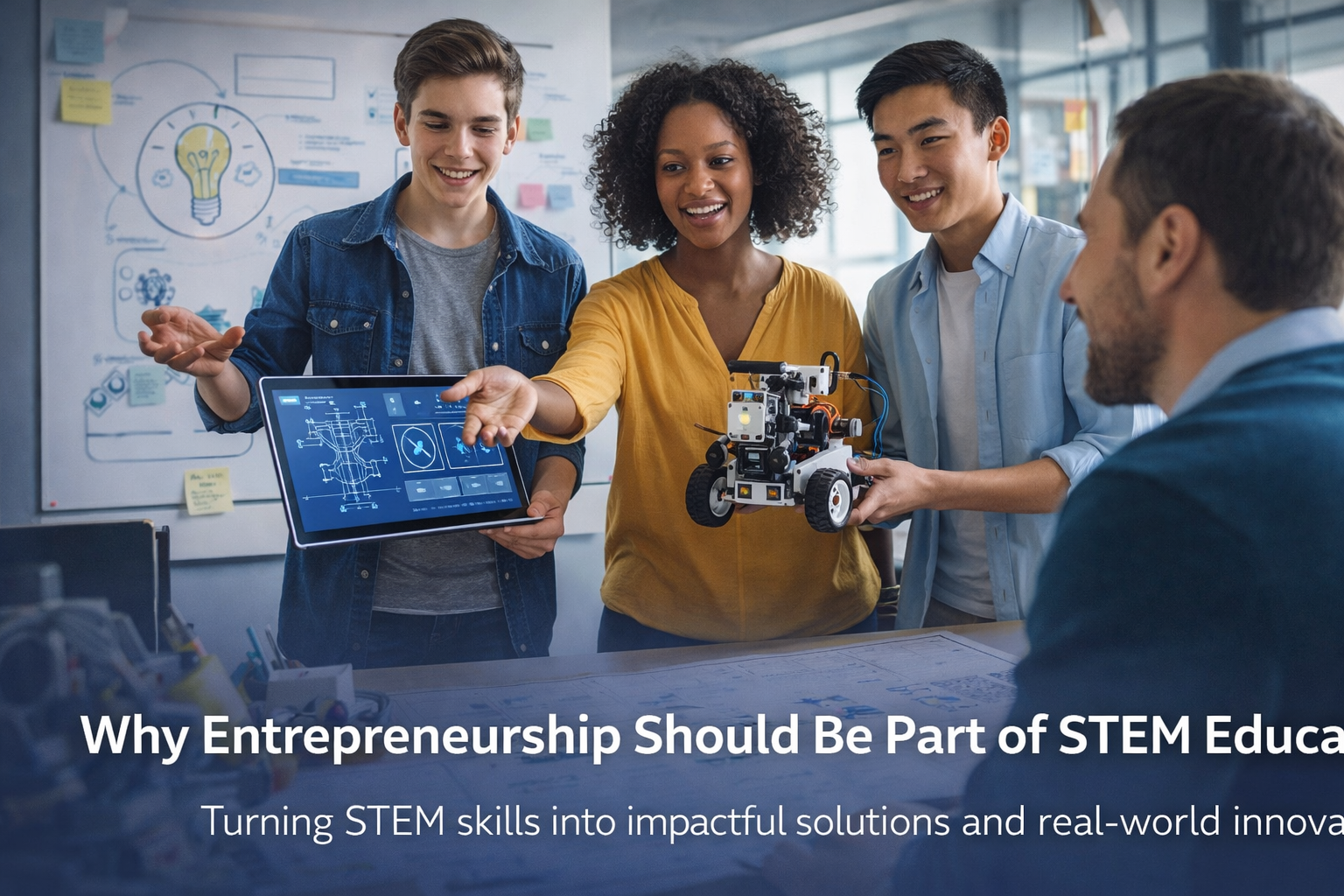
Why Entrepreneurship Should Be Part of STEM Education
STEM education already gives students a strong foundation in science, technology, engineering, and mathematics. It helps them think critically, solve problems, and approach challenges with logic and creativity. But in today’s world, technical knowledge alone is not always enough. Students also need to understand how ideas become solutions, how innovation creates value, and how problems in the real world can lead to meaningful opportunities. That is why entrepreneurship should be part of STEM education. NSTA’s official position on STEM states that high-quality STEM education helps foster the next generation of innovators and entrepreneurs, while emphasizing real-world application, problem solving, communication, and creative thinking.
Entrepreneurship in STEM education does not mean turning every student into a business owner. It means helping learners develop an entrepreneurial mindset: the ability to identify problems, recognize opportunities, test ideas, improve solutions, and communicate value clearly. That mindset fits naturally with STEM because both fields are rooted in inquiry, experimentation, and practical action. When students learn to connect technical skills with initiative and innovation, they become better prepared for the future. UNESCO has highlighted that technical education often lacks entrepreneurship, leaving many learners underprepared to turn ideas into impactful ventures, while its science and engineering entrepreneurship bootcamps are specifically designed to help young innovators strengthen engineering, leadership, and real-world impact.
For SkillUp, this connection is especially relevant. The company’s mission is centered on empowering education and entrepreneurship, and its services already combine STEM learning for students with online education in applied engineering and business management, as well as consulting for entrepreneurs to optimize business operations and support sustainable growth. That makes entrepreneurship in STEM education not only a strong SEO topic for the site, but also a natural extension of the brand’s actual positioning.
STEM and entrepreneurship belong together
At their core, STEM and entrepreneurship solve the same kind of problem from different angles. STEM helps students understand how things work and how to build or improve them. Entrepreneurship helps them ask why a solution matters, who it helps, and how it can create impact in the real world. When these two approaches are combined, students move beyond theory. They begin to see that innovation is not only about invention, but also about usefulness, relevance, and implementation. NSTA describes STEM as experiential, interdisciplinary learning tied to authentic problems and college-and-career readiness, which makes entrepreneurship a natural complement rather than a separate topic.
This is also how many major innovation systems operate in practice. NSF’s I-Corps program exists to train an entrepreneurial workforce and help scientists and engineers move from invention to impact through experiential education. That is a strong signal that entrepreneurship is not outside the world of STEM; it is one of the mechanisms through which STEM knowledge creates economic and social value.
1. It helps students connect ideas to real-world impact
One of the strongest reasons entrepreneurship should be part of STEM education is that it helps students understand that knowledge is meant to be used. A student may be able to code, design a prototype, or understand an engineering concept, but entrepreneurship adds an important question: how can this solve a real problem for real people?
That shift matters. It encourages students to think about needs, users, context, and practical value. Instead of building something only because it is technically possible, they begin to think about whether it is useful, sustainable, and worth improving. UNESCO’s entrepreneurship bootcamps are built around exactly this gap, helping technically skilled young people learn how to turn ideas into impactful solutions in fields like health, energy, agriculture, and water.
2. It strengthens creativity, initiative, and innovation
STEM education already supports creative problem-solving, but entrepreneurship pushes that creativity further. It asks students not only to solve a challenge, but to identify opportunities, generate original ideas, and take initiative. This encourages a more active form of learning, where students do not wait for answers but begin exploring possibilities on their own.
That matters because the future will reward people who can adapt, improve, and create. NSTA explicitly links STEM education to innovation, entrepreneurship, creative thinking, teamwork, and communication. In other words, entrepreneurship is not a distraction from STEM goals. It reinforces several of the very outcomes that high-quality STEM education is supposed to develop.
3. It builds leadership and communication skills
Students with strong technical abilities do not always receive enough practice in explaining ideas, persuading others, or presenting solutions clearly. Entrepreneurship helps close that gap. It encourages learners to communicate what they are building, why it matters, and how it works. Those communication habits are valuable in school, in professional life, and in collaborative environments.
UNESCO’s science and engineering entrepreneurship model emphasizes mentorship, peer collaboration, leadership, and practical training, not just technical expertise. That is important because real innovation often depends on more than technical skill alone. Students also need confidence, teamwork, and the ability to share ideas effectively.
4. It encourages resilience and iterative thinking
Entrepreneurship teaches students something that is essential in both innovation and life: not every first idea works. Learners may need to adjust a design, rethink a concept, or respond to feedback. That iterative mindset fits perfectly with STEM learning, where testing, revising, and improving are already central to the process.
When students experience entrepreneurship as part of STEM, they begin to understand failure differently. It becomes feedback, not defeat. They learn that progress often comes through reflection and refinement. That kind of resilience supports deeper learning and helps students become more independent, confident problem-solvers. This is a reasonable educational inference from the experiential, problem-centered models described by NSTA and NSF.
5. It prepares students for more than one future path
Not every student will become an engineer, scientist, or founder. But many will work in environments where they need to think creatively, identify opportunities, improve systems, and contribute to innovation. Entrepreneurship in STEM education helps prepare students for that broader reality.
NSF describes I-Corps as training an entrepreneurial workforce and accelerating the societal and economic benefits of research through experiential learning. That supports a broader point: entrepreneurship is not only about startups. It is also about helping people use knowledge in practical, value-creating ways. For students, that means entrepreneurship can be useful whether they pursue business, technology, design, research, education, or community leadership.
6. It aligns perfectly with project-based STEM learning
Entrepreneurship is especially powerful when combined with project-based learning. In STEM classrooms, students often work on prototypes, experiments, sustainability challenges, coding tasks, or design problems. Entrepreneurship adds another layer by encouraging students to consider audience, impact, feasibility, and implementation.
That makes projects feel more authentic. Students are not only completing an assignment for a grade. They are thinking like creators, innovators, and solution-builders. Since SkillUp already positions its educational offer around innovation, STEM learning, and entrepreneurship, this integrated model fits very well with the brand’s identity and future content strategy.
Why this topic fits SkillUp
This article is strategically strong for SkillUp because it sits at the exact intersection of the brand’s services. SkillUp presents itself as an organization focused on empowering education and entrepreneurship, offers STEM courses for students, plans online courses in applied engineering and business management, and provides consulting for entrepreneurs. Publishing content around entrepreneurship in STEM education helps the site build topical authority across all three pillars at once: student education, online learning, and entrepreneurial growth.
Conclusion
Entrepreneurship should be part of STEM education because it helps students do more than learn concepts. It helps them apply ideas, recognize opportunities, communicate solutions, and think about impact in the real world. When students combine technical knowledge with entrepreneurial thinking, they become more creative, more resilient, and better prepared for future challenges.
STEM teaches students how to understand and build. Entrepreneurship teaches them how to connect those skills to real needs and meaningful outcomes. Together, they create a more complete kind of education—one that prepares students not only to succeed academically, but also to innovate, lead, and contribute in a rapidly changing world. That integrated vision closely matches both current STEM education guidance and SkillUp’s own identity as a brand built around education, innovation, and entrepreneurship.
FAQ
Why is entrepreneurship important in STEM education?
Entrepreneurship is important in STEM education because it helps students connect technical knowledge to real-world problems, build innovative solutions, and communicate the value of what they create.
Does entrepreneurship in STEM mean students need to start businesses?
No. In education, entrepreneurship often means developing an entrepreneurial mindset: identifying opportunities, solving problems, taking initiative, and improving ideas through action.
How does entrepreneurship support STEM skills?
It strengthens skills that already matter in STEM, including creativity, problem-solving, communication, collaboration, and iterative thinking.
Why is this topic relevant for SkillUp?
It is relevant because SkillUp already combines STEM education for students, future e-learning in applied engineering and business management, and consulting services for entrepreneurs under a mission centered on education and entrepreneurship.