Traditional education is still essential, but today’s students need more than memorization and test-taking skills. They need to learn how to ask questions, solve problems, think creatively, and apply knowledge in real situations. That is exactly where STEM education becomes so valuable. Modern STEM education is designed to help learners connect science, technology, engineering, and mathematics to real-world challenges while building the kind of thinking skills they will need in school, work, and everyday life. Federal STEM strategy documents also describe STEM learning as a way to strengthen problem-solving, design, critical thinking, and connections between school, work, and the wider world.
At SkillUp, this kind of learning is central to the company’s mission. The organization offers hands-on STEAM courses for students ages 10 to 18, supports online learning through its upcoming e-learning platform, and connects education with innovation and entrepreneurship. Its student programs already emphasize robotics, programming, sustainability, engineering design, and project development, which makes STEM education more than a theory—it becomes an active learning experience.
What is STEM education?
STEM stands for Science, Technology, Engineering, and Mathematics. In practice, STEM education is an interdisciplinary approach that helps students learn these subjects in connected and meaningful ways instead of treating them as isolated topics. Rather than simply reading about how something works, students are encouraged to investigate, design, build, test, improve, and explain their ideas. National STEM education frameworks describe this kind of learning as one that develops higher-order thinking, design, inference, adaptability, and problem-solving through authentic contexts.
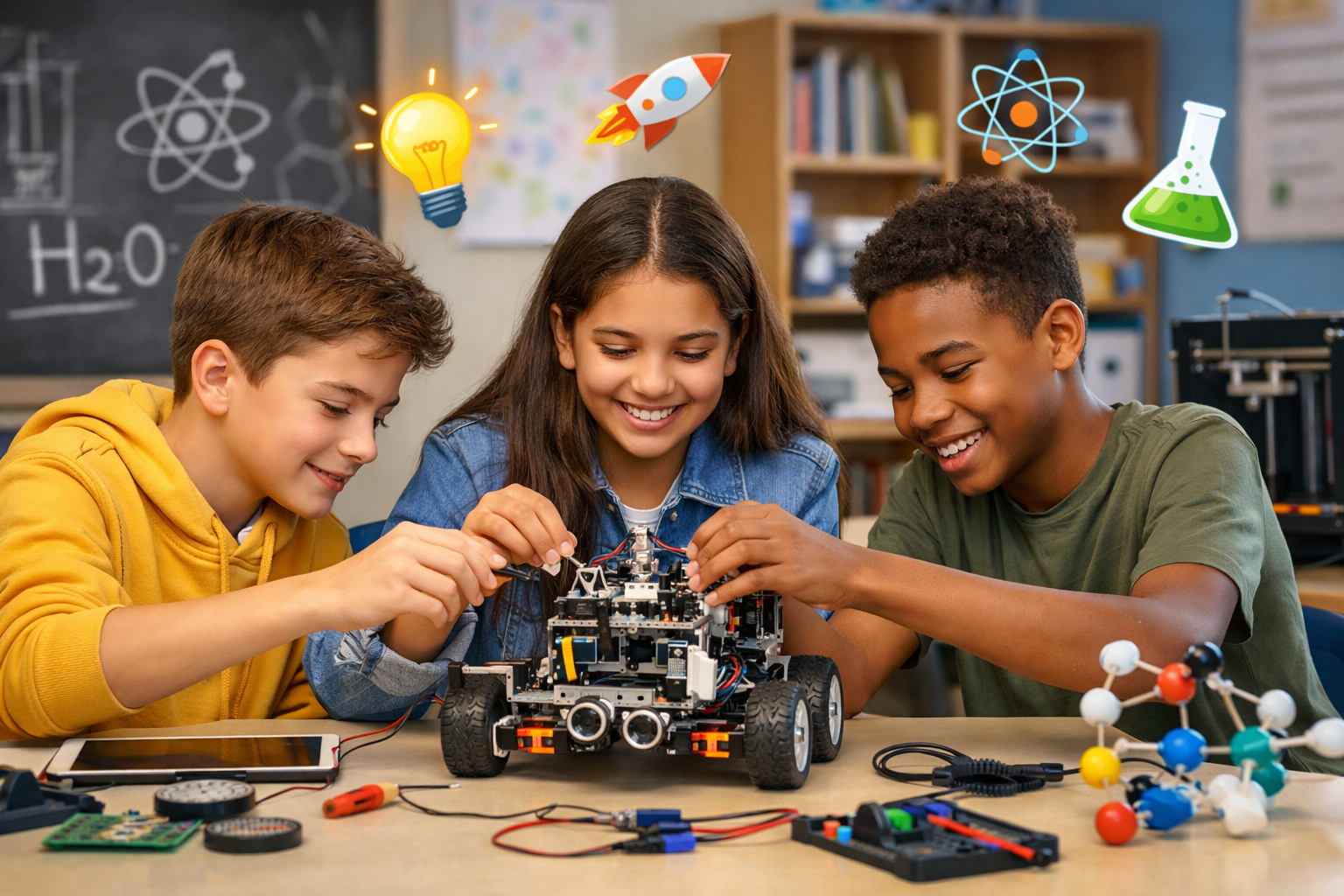
For example, a STEM lesson might ask students to design a simple water filter, build a small solar-powered model, or create a basic coded program. In one project, they may use science to understand a problem, math to measure and evaluate it, technology to support the solution, and engineering to build and improve a prototype. That integrated model helps students see learning as useful, practical, and connected to the real world. SkillUp’s own student course outline reflects this approach by combining foundations of engineering, programming, renewable energy, sustainability, prototyping, and final project presentations.
Why is STEM education important for students today?
The world students are growing into is changing quickly. Technology shapes almost every industry, and future opportunities increasingly depend on digital fluency, analytical thinking, adaptability, and innovation. STEM education matters because it prepares students for that reality early. Federal STEM planning documents emphasize that strong STEM teaching and learning helps prepare learners to contribute to their communities and pursue a wide range of career opportunities, including emerging pathways shaped by technology and innovation.
More importantly, STEM education does not only prepare students for “STEM jobs.” It helps them become better thinkers. A student who learns to identify a problem, test ideas, analyze results, and improve a solution is developing a mindset that is useful in nearly every profession. Whether a learner becomes an engineer, entrepreneur, teacher, designer, healthcare worker, or business owner, those habits of thought remain valuable. That is one reason modern STEM strategy documents focus not only on content knowledge, but also on skills like reasoning, persistence, collaboration, and creativity.
Key benefits of STEM education
1. It builds critical thinking and problem-solving skills
One of the biggest strengths of STEM education is that it teaches students how to think, not just what to remember. When students are asked to solve a challenge or create a project, they must observe, ask questions, evaluate options, and make decisions. This active process strengthens critical thinking and helps students become more independent learners. SkillUp highlights these same outcomes in its school offerings, noting a focus on critical thinking, problem-solving, and teamwork.
2. It encourages creativity and innovation
Many people assume STEM is only technical, but strong STEM learning also includes creativity. Students must imagine solutions, test different ideas, and adapt when something does not work. Innovation often begins with curiosity, and STEM classrooms give students space to experiment and improve. SkillUp extends this model through design, prototyping, innovation, and product development in its student programs.
3. It connects learning to real life
Students are more engaged when they understand why a lesson matters. STEM education makes learning more relevant by connecting classroom concepts to everyday problems and real applications. Building a prototype, exploring renewable energy, or creating a basic program shows students that what they learn can be used to improve systems, solve challenges, and create new ideas. SkillUp’s curriculum uses hands-on activities and real-world applications specifically to inspire curiosity and future career readiness.
4. It supports collaboration and communication
Great ideas rarely happen in isolation. Many STEM activities involve teamwork, discussion, planning, and presentation. Students learn how to share ideas, listen to others, divide responsibilities, and communicate results clearly. These skills are essential both in school and in professional life. SkillUp’s course structure includes collaborative projects and final presentations, reinforcing communication as part of the learning process.
5. It prepares students for future opportunities
As industries evolve, students need a learning foundation that keeps them adaptable. STEM education helps create that foundation. Official U.S. STEM strategy materials link high-quality STEM learning to workforce readiness, innovation, and broader access to opportunity across multiple career pathways. For students, this means more than future employment—it means being better prepared to understand the world, use technology responsibly, and participate confidently in a changing society.
How schools and families can support STEM learning
Supporting STEM learning does not always require expensive equipment or advanced labs. Schools can begin with project-based learning, hands-on experiments, coding basics, design challenges, and discussions about real problems in the community. Families can support STEM at home by encouraging curiosity, asking open-ended questions, exploring how things work, and helping children see mistakes as part of learning. That mindset is especially important because STEM education thrives when students feel safe to test, fail, reflect, and try again. SkillUp’s educational model reflects this by combining structured instruction with interactive activities, practical projects, and supportive learning environments.
Why STEM education fits SkillUp’s mission
SkillUp’s mission is built around empowering education and entrepreneurship through innovation. Its services already connect student learning with engineering foundations, programming, renewable energy, project management, and entrepreneurial thinking. The site also positions its consulting services as a way to improve productive processes through applied engineering, which reinforces the broader value of STEM thinking beyond the classroom. In that sense, SkillUp is not only teaching subjects—it is helping students and entrepreneurs develop the mindset to create solutions, improve systems, and grow through knowledge.
Conclusion
So, what is STEM education? It is an approach to learning that combines science, technology, engineering, and mathematics to help students build practical knowledge and future-ready skills. And why is it important for students today? Because the modern world requires more than memorized information. Students need to think critically, solve problems, adapt, collaborate, and create. STEM education helps them do exactly that while making learning more meaningful and connected to real life. For schools, families, and organizations like SkillUp, investing in STEM means investing in learners who are ready to grow, innovate, and lead.
FAQ
What is STEM education in simple words?
STEM education is a way of teaching that combines science, technology, engineering, and mathematics through practical, problem-solving activities that help students apply what they learn.
Why is STEM education important?
STEM education is important because it helps students develop critical thinking, creativity, collaboration, and problem-solving skills that are valuable in school, work, and everyday life.
At what age should students start STEM education?
Students can begin STEM learning at an early age through simple hands-on activities. SkillUp’s student programs are designed for learners ages 10 to 18.
Is STEM education only for students who want technical careers?
No. STEM education is useful for all students because it teaches transferable skills such as reasoning, innovation, teamwork, and adaptability that apply across many careers and life situations.