
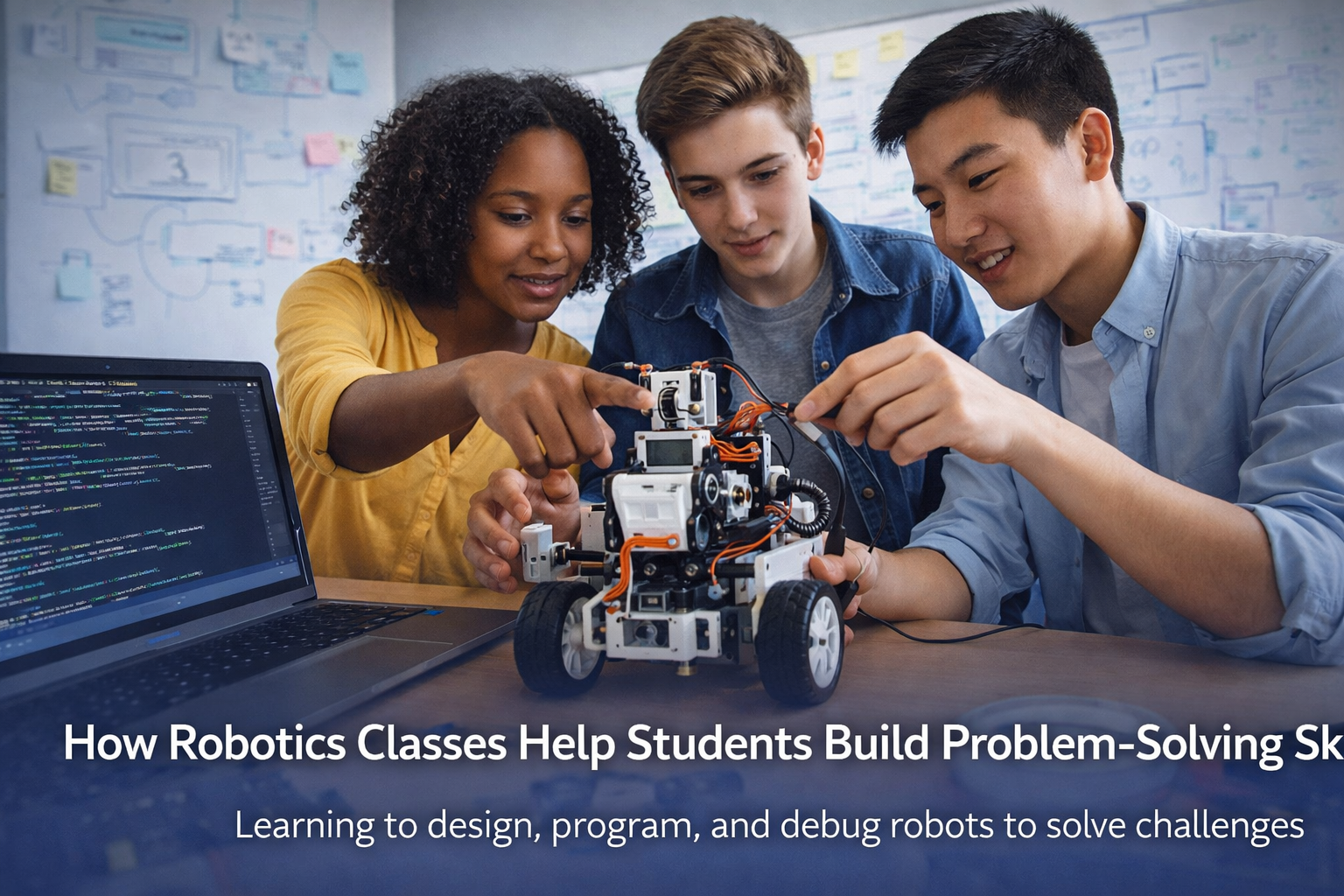
How Robotics Classes Help Students Build Problem-Solving Skills
Robotics classes are becoming one of the most effective ways to make STEM education practical, exciting, and meaningful for students. Instead of only learning ideas through textbooks or lectures, students in robotics programs are asked to design, build, test, troubleshoot, and improve. That process turns learning into action. It also creates one of the strongest conditions for developing problem-solving skills, because students must think through challenges instead of simply memorizing answers. Research on integrated robotics curricula has found that robotics activities provide a meaningful context for applying STEM concepts to real-life problems and can support the development of computational thinking, problem-solving, creativity, persistence, social interaction, and teamwork.
For SkillUp, this topic fits naturally with the brand’s educational direction. The site already presents dynamic STEAM courses for students aged 10 to 18 and emphasizes innovation, technology, and essential skills for future career paths. It also highlights robotics as part of the kind of hands-on technological experience that helps prepare students for emerging industries.
Why robotics is so powerful in STEM learning
Robotics is powerful because it combines multiple disciplines into one active learning experience. A student may need to use logic, measurement, coding, design, engineering thinking, and teamwork in a single project. That makes robotics far more than a technical activity. It becomes an environment where students learn how to approach problems from different angles and keep improving until they find something that works.
This matters because problem-solving is not built through passive learning. Students develop it when they face challenges, test ideas, and adapt based on results. Robotics creates exactly that kind of learning experience. According to research published through NSF-supported channels, robotics education helps students understand engineering principles while also enhancing problem-solving and critical-thinking skills.
1. Robotics classes teach students how to break down complex problems
One of the first things students learn in robotics is that large challenges become more manageable when they are broken into smaller parts. A robot may not move correctly, respond to commands, or complete a task as expected. To solve that, students have to identify the exact issue. Is the problem in the programming, the design, the wiring, the motor, or the logic behind the instructions?
That process teaches decomposition, which is a core part of both computational thinking and real-world problem-solving. Instead of feeling overwhelmed by a challenge, students begin to look at it step by step. They learn how to isolate variables, analyze causes, and focus on one part of the problem at a time. Research on robotics education and student–robot interaction has found that robotics environments can cultivate computational thinking and that increased engagement with these environments is associated with stronger growth in those skills.
2. Students learn through testing and debugging
In robotics classes, things rarely work perfectly on the first try. That is part of what makes them so educational. Students write code, build mechanisms, or design a robot path, and then they test it. When the robot does not behave as expected, they must debug the issue.
Debugging is one of the clearest examples of problem-solving in action. Students observe what happened, compare it to what was supposed to happen, make a change, and test again. Through this process, they learn that mistakes are not failures. They are information. They point toward the next improvement.
This kind of iterative learning helps students become more resilient and analytical. Rather than giving up when something does not work, they begin asking better questions and refining their ideas. Research on integrated STEM robotics programs specifically notes the value of robotics for experiential learning, where students create, observe, and interact with physical objects while developing problem-solving skills.
3. Robotics strengthens computational thinking
Problem-solving in robotics is closely connected to computational thinking. Students learn to sequence instructions, recognize patterns, predict outcomes, and create logical solutions. Even when they are not doing advanced programming, they are practicing the foundations of algorithmic thinking.
This is valuable because computational thinking is not limited to computer science. It helps students approach all kinds of problems in a more structured and strategic way. When learners practice planning, sequencing, debugging, and optimizing, they are building habits that can transfer into math, science, engineering, and everyday reasoning.
Research published in the International Journal of Technology and Design Education found that students’ computational thinking skills increased during a robotics summer camp and that the increase was positively correlated with time spent in student–robot interaction.
4. Robotics makes abstract concepts easier to understand
Many STEM concepts can feel abstract when students only encounter them through theory. Robotics changes that by making learning tangible. Students can see how a sensor responds, how a programmed instruction changes movement, or how a design decision affects performance.
That hands-on element is important because it helps students connect ideas to real outcomes. Instead of hearing about systems and logic in a purely theoretical way, they experience them directly. Research on elementary robotics curricula notes that robotics activities can situate the learning of abstract concepts through experiential learning and meaningful application.
When students can see and test what they are learning, problem-solving becomes more concrete. They are not solving imaginary problems. They are solving visible, practical challenges in front of them.
5. Robotics encourages teamwork and communication
Problem-solving is rarely a solo skill in real life. Most meaningful challenges require communication, teamwork, and shared thinking. Robotics classes often involve students working together to design, build, program, and improve a robot. That collaboration teaches them how to explain ideas, listen to feedback, divide responsibilities, and solve disagreements productively.
These social dimensions matter because they strengthen the quality of problem-solving. A student may notice something another missed. One student may be stronger in coding, while another understands design or construction better. Robotics gives students a reason to combine strengths in pursuit of a shared goal.
Research on robotics-integrated STEM learning has identified benefits not only in problem-solving and creativity, but also in social interaction and teamwork skills.
6. Robotics helps students build confidence through action
Confidence often grows when students realize they can solve something difficult. Robotics classes create repeated moments like that. A student begins with a challenge, struggles through trial and error, and eventually makes the robot work better. That visible progress can be incredibly motivating.
This matters especially for students who may not respond as strongly to traditional academic formats. In robotics, learning is active, immediate, and often exciting. Students can see the effect of their decisions and feel ownership of the result. That makes success feel real.
As students solve one challenge after another, they begin to trust their own thinking. They become more willing to experiment, revise, and try again. That confidence is one of the most valuable outcomes of robotics education because it supports future learning well beyond the robotics classroom.
7. Robotics connects students to future-ready skills
Robotics education is not only about building robots. It is about preparing students for a world where technology, automation, engineering, and digital systems are increasingly important. NSF-supported research notes that robotics has become a critical component of modern STEM curricula as automation and AI continue to expand across industries. At the same time, SkillUp’s own content links hands-on technologies such as robotics and coding to future career readiness and innovation.
That makes robotics especially valuable in schools and student programs. It helps learners build problem-solving skills that matter now, while also introducing them to fields and ways of thinking that may shape their future opportunities.
Why this topic fits SkillUp
This is a strong topic for SkillUp because it connects directly to the site’s positioning around innovation, STEAM learning, and future-ready education. The brand already presents itself as helping students explore science, technology, engineering, arts, and mathematics through dynamic, interactive programs for ages 10 to 18. A blog post on robotics and problem-solving supports that positioning while also strengthening topical authority around practical STEM learning.
Conclusion
Robotics classes help students build problem-solving skills because they turn learning into a real process of thinking, testing, adjusting, and improving. Students learn how to break down challenges, debug mistakes, apply logic, collaborate with others, and stay persistent when solutions are not immediate. Those are not only robotics skills. They are life skills.
In a strong STEM program, robotics gives students the chance to experience learning in one of its most powerful forms: active, hands-on, and purposeful. For organizations like SkillUp, this makes robotics an ideal subject for helping students become curious thinkers, capable creators, and confident problem-solvers ready for the future.
FAQ
How do robotics classes improve problem-solving skills?
Robotics classes improve problem-solving skills by teaching students how to test ideas, debug mistakes, analyze causes, and refine solutions through hands-on challenges.
Why is robotics important in STEM education?
Robotics is important in STEM education because it combines engineering, coding, logic, design, and teamwork in a practical environment that helps students apply knowledge to real problems.
Do robotics classes help with computational thinking?
Yes. Research shows that robotics learning environments can cultivate computational thinking, including sequencing, logic, debugging, and structured reasoning.
Is robotics useful for students even if they do not want a technical career?
Yes. Robotics helps students build transferable skills such as critical thinking, collaboration, persistence, and confidence, which are valuable across many subjects and future careers.