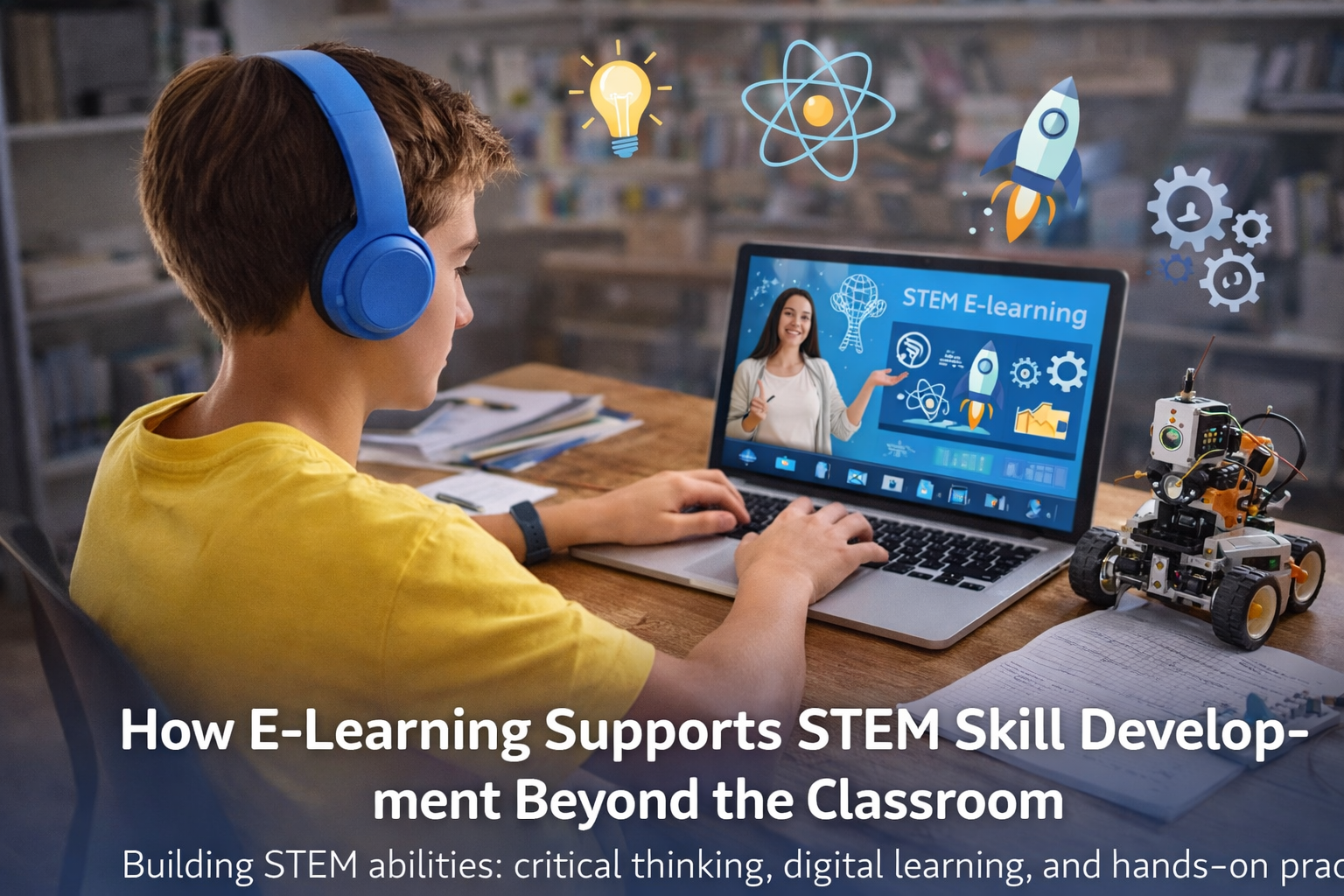
How E-Learning Supports STEM Skill Development Beyond the Classroom
Learning no longer begins and ends when the school bell rings. Today, students can explore ideas, develop skills, and continue building knowledge far beyond the physical classroom. This shift is especially important in STEM education, where curiosity, experimentation, and consistent practice play a major role in long-term growth. E-learning makes that continued development possible by giving students more flexible access to meaningful educational experiences, wherever they are. UNESCO describes digital learning and digital competencies as increasingly important for lifelong learning, participation in society, and future employment opportunities.
When designed well, e-learning does much more than place lessons on a screen. It can help students strengthen critical thinking, creativity, problem-solving, digital confidence, and independent learning habits. In STEM education, this matters because strong learning often happens through repeated exposure, interactive practice, and the ability to apply concepts in real contexts. The National Science Teaching Association describes STEM education as an experiential approach that integrates knowledge and skills through in-context projects or problems tied to college and career readiness.
For SkillUp, this topic is especially relevant. The company already offers STEM-focused learning experiences for students ages 10 to 18 through courses that include engineering foundations, programming, renewable energy, sustainability, innovation, project development, and final presentations. Its site also includes an e-learning platform page labeled “coming soon,” which makes this article a strong fit for both current authority building and future SEO positioning.
Why e-learning matters in STEM education
STEM learning is most effective when students have opportunities to revisit concepts, test ideas, and stay actively engaged with what they are learning. E-learning helps support that process by extending access beyond the classroom. Instead of depending only on one lesson or one physical environment, students can continue learning at home, explore topics at their own pace, and engage with content more than once. UNESCO’s work on digital education emphasizes that high-quality digital learning can expand access while supporting critical thinking, human agency, and meaningful participation in education.
This flexibility can be especially valuable in STEM subjects, where students often need time to process new concepts and connect theory to practice. Some students learn quickly and want to go deeper. Others benefit from reviewing lessons, repeating tasks, or taking more time to build confidence. E-learning creates space for both. It gives learners more control over pace and repetition, which can make STEM subjects feel more accessible and less intimidating.
1. E-learning encourages self-paced exploration
One of the biggest advantages of e-learning is that it supports self-paced learning. In a traditional classroom, time is fixed. Online learning allows students to pause, review, revisit key concepts, and move forward when they are ready. That matters in STEM because understanding often develops step by step.
A student learning coding, engineering concepts, or scientific reasoning may need time to experiment and reflect. When learners are able to engage at a pace that matches their needs, they are often more likely to build confidence and retain what they learn. Digital education frameworks from UNESCO also emphasize the importance of learner-centered models that support meaningful skill development rather than passive content delivery.
2. It strengthens digital confidence alongside STEM knowledge
STEM skill development today is closely connected to digital competence. Students are not only learning science, math, or engineering ideas. They are also learning how to work in digital environments, navigate online resources, interpret multimedia content, and use technology as a learning tool.
That combination is valuable because digital confidence is now part of future readiness. UNESCO notes that digital competencies have become crucial for lifelong learning and participation in society. When students learn STEM through online environments, they often build both subject knowledge and confidence using technology in purposeful ways.
3. E-learning supports consistent practice beyond class time
STEM skills improve with practice. Problem-solving, logical thinking, experimentation, and design do not usually grow from one isolated lesson. They develop over time through repeated engagement. E-learning makes that repetition more realistic by giving students ways to continue exploring ideas after school hours.
For example, a learner might revisit a recorded explanation, complete an online challenge, work through a guided task, or continue developing a project independently. This type of extended access helps turn a classroom concept into a more durable skill. It also supports the idea that learning is an ongoing process rather than a one-time event.
4. It can make STEM learning more interactive and engaging
Good e-learning is not just about reading text on a screen. The most effective digital learning experiences are interactive. They can include quizzes, simulations, guided exercises, project prompts, collaborative tasks, visual demonstrations, and creative challenges. In STEM learning, these elements are especially useful because students benefit from seeing systems, testing outcomes, and applying ideas in context.
Research and policy discussions around STEM and digital learning consistently point to the value of active engagement and practical application. SkillUp’s own content also emphasizes hands-on, project-based learning as a way to deepen student engagement and build real-world skills.
5. E-learning helps connect classroom learning to real life
One reason students disengage from STEM is that they sometimes fail to see how it connects to the real world. E-learning can help bridge that gap when courses include applied examples, design challenges, sustainability topics, coding projects, or engineering-based problem-solving.
This connection matters because STEM learning becomes more meaningful when students understand its purpose. SkillUp’s student programs already reflect this applied approach through topics such as renewable energy, project management, innovation, and final project presentations. E-learning can extend that same spirit beyond the classroom by helping students continue building practical, relevant skills in flexible settings.
6. It supports independent learning habits
Another major strength of e-learning is that it can help students become more independent learners. In online environments, students often need to manage their time, follow instructions carefully, revisit material on their own, and take more ownership of progress. These habits are valuable in STEM education, where persistence and self-direction often make a major difference.
Independent learning is also important because future success will depend on the ability to keep learning over time. SkillUp’s broader mission connects education with innovation and entrepreneurship, which makes self-direction especially relevant. Students who learn how to manage their own growth are better prepared not only for school, but also for future careers and entrepreneurial thinking.
7. E-learning can broaden access to STEM opportunities
Not every student has the same access to in-person enrichment, specialized programs, or extra academic support. One of the promises of digital learning is that it can help extend opportunities more broadly when implemented thoughtfully. UNESCO has highlighted digital learning’s potential to improve access and equity, especially when institutions focus on practical, inclusive design rather than assuming technology alone solves every challenge.
For STEM education, this broader access can be meaningful. Students who might not otherwise explore coding, robotics, sustainability, or innovation topics may be able to engage with them online. That does not replace great teaching or hands-on learning, but it can expand the pathways through which students discover interest and build confidence.
Why this topic fits SkillUp’s growth strategy
This article aligns naturally with SkillUp’s positioning. The site already presents itself as a provider of STEM education for students and as a future provider of online learning through its e-learning platform. Publishing content around how e-learning supports STEM skill development helps the brand strengthen topical authority in two connected areas at once: STEM education and digital learning. It also creates a logical bridge between the current student programs and the future online platform without overstating what is already available on the site.
Conclusion
E-learning supports STEM skill development by extending learning beyond the classroom in ways that are flexible, interactive, and practical. It helps students review concepts at their own pace, build digital confidence, practice more consistently, and connect ideas to real-world challenges. When combined with thoughtful course design and active learning strategies, online education can become a powerful tool for building the skills students need for the future.
For organizations like SkillUp, e-learning is more than a delivery format. It is an opportunity to help students keep exploring, creating, and growing outside traditional classroom limits. And in STEM education, that continued access can make a lasting difference.
FAQ
How does e-learning support STEM skill development?
E-learning supports STEM skill development by giving students flexible access to interactive lessons, repeated practice, digital tools, and project-based activities that strengthen problem-solving, critical thinking, and confidence.
Why is e-learning useful for STEM students?
E-learning is useful for STEM students because it allows them to learn at their own pace, review complex ideas, continue practicing outside class, and build digital competencies alongside STEM knowledge.
Can e-learning replace hands-on STEM learning?
E-learning works best when it supports active and practical learning rather than replacing it entirely. Strong online STEM programs often include project prompts, applied tasks, and opportunities to connect digital lessons with hands-on experiences.
What STEM skills can students build through online learning?
Students can build critical thinking, problem-solving, digital confidence, creativity, independent learning habits, and practical understanding of subjects such as coding, engineering, and applied science through well-designed online learning experiences.